

09.16.2026 PropStream
Disclaimer: This article is intended for educational purposes only and should not be considered legal, financial, tax, or investment advice. Distressed property owners may be facing difficult financial, personal, or life circumstances. Investors should always conduct their own due diligence, comply with applicable laws and regulations, and approach homeowners with professionalism, respect, and empathy.
|
Key Takeaways:
|
Every real estate investment strategy starts with one goal: finding opportunities before everyone else does.
For many investors, searching for distressed properties is one of the most effective ways to find off-market opportunities. But a property in poor condition alone doesn't guarantee a motivated seller. The real advantage lies in identifying the financial, physical, or ownership-related challenges impacting the property owner, enabling investors to connect with motivated sellers before other investors recognize the opportunity.
But what exactly qualifies as a distressed property, and where can investors find them? Let's explore various distress signals and actionable methods investors use to identify these opportunities early.
What Are Distressed Properties?

A distressed property is a home where financial, physical, or ownership-related challenges may motivate the owner to sell.
The homeowner may be behind on mortgage payments, struggling with unpaid property taxes, managing an inherited property, facing divorce, or dealing with costly repairs they can no longer afford, and hence, distress can take many forms, not just the property condition.
Visible signs of distress can help investors narrow their search, but they rarely tell the whole story. Many beginner investors focus solely on what they can see from the street and come back empty-handed. In most cases, taking the time to evaluate otherwise hidden distress signals can help connect the dots and identify more solid opportunities.
Let's take a closer look at some of the most notable distress signals investors should watch for.
Common Distress Signals Investors Should Watch For
Distressed properties rarely appear overnight. In many cases, warning signs emerge months before a property is listed for sale or enters foreclosure. Think of these as the first layer of qualification before conducting deeper research and outreach.
Pros and Cons of Buying Distressed Properties
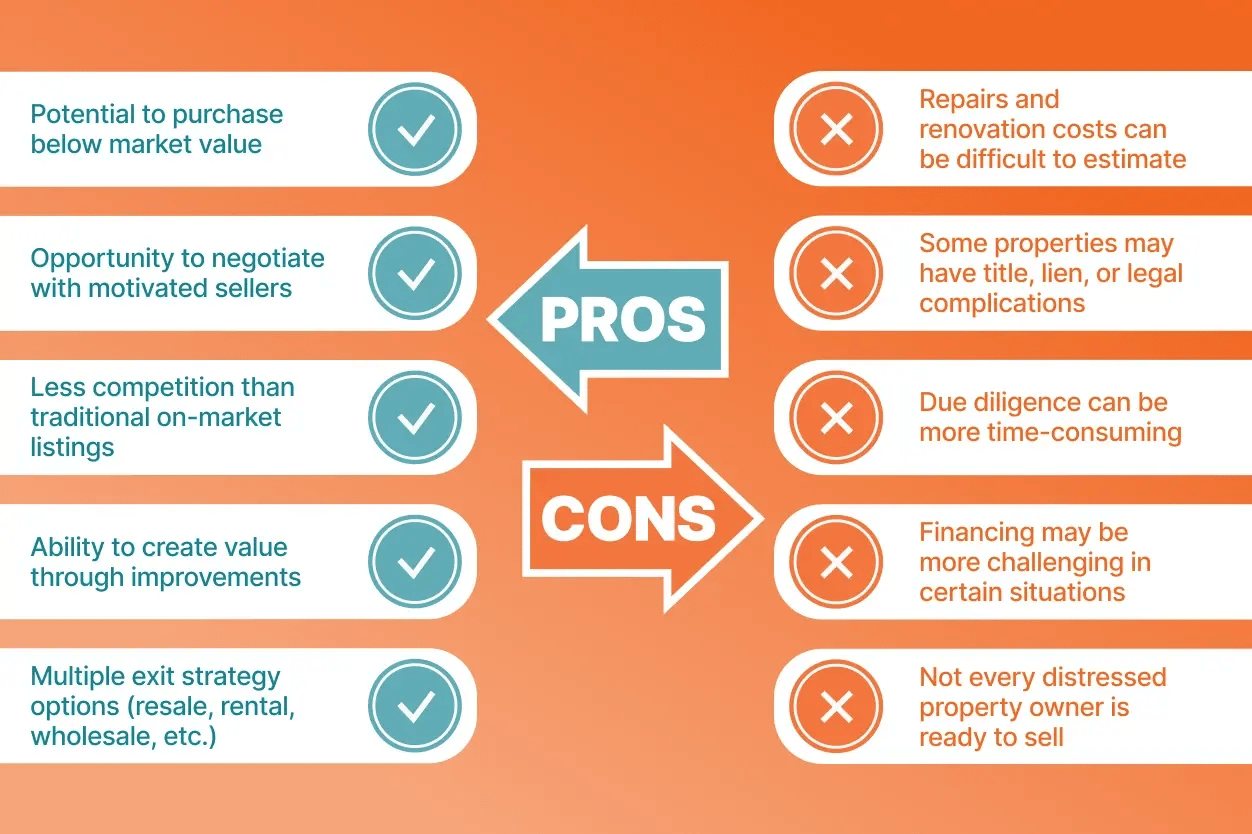
Distressed properties can create opportunities for a variety of real estate professionals, from wholesalers and fix-and-flippers to buy-and-hold investors.
However, every opportunity comes with its own risks and considerations.
| Pros | Cons |
| Potential to purchase below market value | Repairs and renovation costs can be difficult to estimate |
| Opportunity to negotiate with motivated sellers | Some properties may have title, lien, or legal complications |
| Less competition than traditional on-market listings | Due diligence can be more time-consuming |
| Ability to create value through improvements | Financing may be more challenging in certain situations |
| Multiple exit strategy options (resale, rental, wholesale, etc.) | Not every distressed property owner is ready to sell |
Pro Tip: The most worthwhile distressed property leads are often found at the intersection of multiple distress signals. A single indicator may suggest mild selling motivation, but several indicators working together can reveal a much stronger desire to offload the property.
Investor Spotlight Tip: Approach Distressed Property Owners With Empathy and ProfessionalismWhile investors often focus on the property, successful conversations usually begin by understanding the homeowner's goals. Rather than leading with an offer, take time to ask questions, listen carefully, and understand the outcome the owner hopes to achieve. Not every distressed property owner is ready to sell immediately. In many cases, building trust and providing helpful information can be more valuable than pushing for a transaction. The investors who consistently find opportunities are often those who approach conversations with professionalism, patience, and a genuine desire to help solve a problem. The goal isn't simply to buy a property—it's to provide a potential solution during a difficult transition. |
Where To Find Distressed Properties
Think of distress signals as breadcrumbs. Once you know what to look for, the next step is following those clues to the homeowners behind them.
Successful investors combine traditional research methods with aggregated property data to uncover opportunities that may otherwise go unnoticed.
Here are some of the most effective ways to find distressed properties.
Driving for Dollars

Driving for Dollars involves driving through neighborhoods and identifying properties that show visible signs of distress. Many people practice a form of Driving for Dollars regularly without realizing it, making assumptions about a property's condition based on its appearance and surroundings.
While common indicators such as overgrown yards, broken windows, accumulated mail, exterior damage, and other signs of neglect can help identify potential opportunities, many investors use platforms like the PropStream Mobile App on the go to mark properties of interest for continued research afterward.
Attend Local Auctions
Attending local foreclosure and tax auctions can be another way to find distressed properties. These auctions typically feature properties whose owners have fallen behind on mortgage payments or property taxes, resulting in a forced sale, and the property goes to the highest bidder.
If you’re attending a local auction intending to purchase a distressed property, have cash on hand. Many auctions have strict payment timelines, and financing may not be an option.
Pro Tip: If you find yourself unable to bring cash to auctions, consider adding cash buyers (often other, more experienced investors) to your network. They may be willing to lend you the cash you need to invest in a property if the numbers make sense and they see potential in the opportunity.
Another important tip for participating in auctions: Don't let the excitement of bidding overshadow your research. A property's title, liens, condition, and occupancy status can all affect the outcome of the deal. For this reason, investors should conduct thorough due diligence before placing a bid.
Related Read: 5 Things You Need to Know Before Buying a Property at Auction
Build a Local Network

Not every distressed property lead comes from public records or lead lists. Real estate agents, probate attorneys, bankruptcy attorneys, contractors, property managers, and title professionals often encounter homeowners facing financial, legal, or life events that may lead to a sale.
Building mutually beneficial relationships with these professionals can help investors gain early visibility into properties and stay informed before they reach the general market.
Review County Tax and Court Records
County tax records and court filings can be valuable public sources of distressed property leads.
Local courthouses and tax assessor's offices often maintain tax delinquency records, foreclosure filings, probate cases, bankruptcy proceedings, and other public records that may reveal homeowners facing financial or ownership-related challenges.
While these records are often publicly available, researching them manually can be time-consuming, especially across multiple counties and markets. However, when combined with other distress signals, they can help investors identify potential opportunities before they become widely known.
Pro Tip: Want to learn more about tax-delinquent properties? PropStream Academy's free course, The Curious Records of Tax Delinquencies, explores how tax delinquencies work, how to identify potential opportunities, and how to build focused lead lists using PropStream.
Search for Bank-Owned Properties (REOs)
Not every foreclosure property sells at auction. When a property fails to attract a buyer, ownership typically transfers to the lender and becomes what is known as a Real Estate Owned (REO) or bank-owned property.
Pro Tip: PropStream offers a Bank Owned Lead List to help you easily find these properties in-app!.webp?width=1538&height=1022&name=bank%20owned%20filter%20in%20propstream%20(1).webp)
Unlike auction properties, REOs are often listed through real estate agents, giving investors more time to evaluate the property, conduct inspections, and secure financing. While competition can be higher than at auctions, bank-owned properties can still present opportunities for investors seeking distressed inventory.
Pro Tip: Many investors combine REO searches with other distress indicators, such as vacancy, property condition, or length of ownership, to identify stronger opportunities.
The methods above have helped investors find distressed properties for decades. The question is: how much time do you want to spend finding opportunities versus acting on them?
How To Find Distressed Property Leads With PropStream
PropStream's robust library of aggregated datasets, filtering capabilities, and built-in outreach tools help investors search, identify, and connect with distressed property owners from a single platform, making it easier to turn distress signals into actionable leads.
Rather than manually searching multiple public records, auction websites, and county databases, investors can leverage PropStream's 20 pre-built Lead Lists to identify properties that have distressed indicators such as:
- Auction Properties
- Bank-Owned (REO) Properties
- Pre-Foreclosures
- Zombie Properties
- Tax Delinquent Properties
- Upside-Down Mortgages
- Divorce Leads
- Vacant Properties
Beyond Lead Lists, investors can further refine their search using over 165 filters covering ownership, equity, mortgage, tax, occupancy, and property characteristics. This allows users to stack multiple distress indicators together and build highly qualified lead lists based on their investment strategy.
A Real-World Example: Property Filters in Action
Here's a real-world example. Using PropStream's Pre-Foreclosure Lead List, a search for pre-foreclosure properties in Austin, Texas, returns 294 properties. While that's a great starting point, not every property will align with your investment strategy.

You can then refine the list by applying the Absentee Owner (Out of State/Out of Country) filter, reducing the results from 294 properties to just 18.

This simple example highlights how quickly investors can move from a broad lead list to a more focused set of opportunities.
Once you've built the lead list, the next step is figuring out which properties are worth pursuing. Instead of reviewing every piece of information, investors can use the PropStream Intelligence Assistant (PSI) to quickly analyze the most vital property details and uncover insights, helping them prioritize the most worthwhile opportunities.
|
You can ask the PSI assistant questions like:
|
Think of the PropStream Intelligence Assistant as your AI-powered research sidekick. Included with all PropStream plans. Start your 7-day free trial to explore it today.
Pro Tip: Found a property worth a closer look? Use PropStream's Rental ROI Calculator or Fix & Flip Analyzer to evaluate potential returns and compare different investment scenarios before reaching out to the owner. The PSI Assistant will even backfill the information for you!
Once you've identified the right opportunities—whether for a fix-and-flip, wholesale deal, or another investment strategy—the next step is connecting with the property owner.
Connect With Property Owners

PropStream lets you skip trace* properties to build lead lists with contact information (email addresses and phone numbers), then quickly launch outreach using built-in calling tools such as Click to Dial or Dialer Campaigns. AI-guided prompts provide helpful talking points based on the available property data, making conversations more informed and productive.
Learn more about dialing from PropStream below.
To support a multi-channel approach, PropStream also offers Direct Mail (Postcards and Letters) and Email Campaigns to maintain consistent communication with property owners.
|
Pro Tip: Found a distressed property worth pursuing? Don't let funding concerns stop you from taking the next step. Through PropStream's LoanGeek integration, investors can explore financing options directly from PropStream. |
Activate Your PropStream Free Trial and Get 50 Free Distressed Property Leads
Homeowners with distressed properties or compromising life circumstances may need an investor like you to help them find a path forward.
With PropStream, you can search, identify, connect, and transact—offering you a robust deal pipeline while solving homeowner problems from a single convenient platform.
*PropStream engages an independent third-party to perform skip tracing.