

07.15.2026 PropStream
Disclaimer: PropStream does not offer legal advice. This article is for informational purposes only. Consult a legal professional before investing in, or contacting the owners of, tax-delinquent properties.
|
Key Takeaways:
|
Tax-delinquent properties are on the rise. As an investor, this could be an opportunity to find more off-market deals, secure below-market prices, and help struggling homeowners.
And yet, many investors overlook tax-delinquent properties or dismiss them as too complicated.
To take advantage of this unique (and potentially lucrative) lead type, read on. In this guide, we’ll explain the tax delinquency process, how investors can get involved early to acquire properties at a discount, and what you must know to ensure a smooth transaction for all parties involved.
What Is Tax Delinquency?
In real estate, tax delinquency means you’re behind on your property taxes.
Property taxes are levied by cities and counties to help fund local services like schools, police, and parks. If a homeowner has overdue property taxes, they’re considered tax-delinquent.
This can happen for many reasons. For example, a homeowner may experience a financial emergency, the death of a primary owner, or confusion about who is responsible for payments. All of these challenges can lead to delayed or missed property tax payments.
Tax Lien vs. Tax Deed Sales
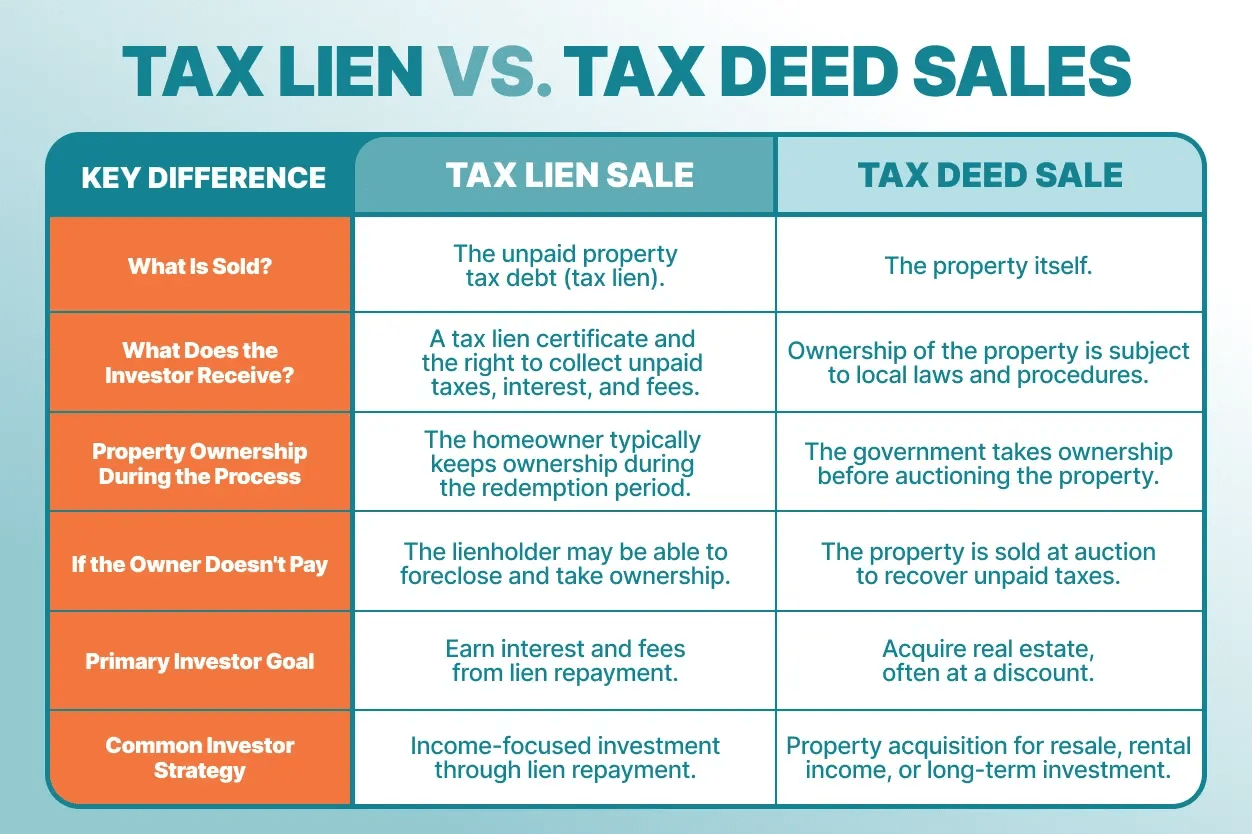
The consequences for tax delinquency vary by jurisdiction.
In tax lien states, the government puts a lien on the property and then auctions the lien in what’s called a tax lien sale. Typically, the highest bidder or the bidder who agrees to charge the property owner the lowest interest rate on the lien wins. The new lienholder is then responsible for collecting the delinquent amount, plus any interest and fees, directly from the homeowner.
If the homeowner fails to pay off the lien within a set redemption period, the lienholder is allowed to foreclose on the property and take ownership.
In tax deed states, a tax lien is also placed on the property. However, the government doesn’t sell the lien. Instead, it holds the lien either until it’s paid off or until the redemption period for resolving the lien passes. If the lien remains unpaid, the government takes ownership of the property and auctions the property itself in a tax deed sale.
|
Important Note: Thanks to a landmark 2023 Supreme Court ruling, the government cannot seize a homeowner’s surplus equity after selling a property for unpaid taxes. Any money remaining after the tax debt, interest, and fees are paid belongs to the homeowner. Typically, they must apply to collect these funds from the local county treasurer’s or tax assessor’s office. |
The Redemption Period and What It Means for Investors
When a homeowner becomes tax-delinquent, they’re typically given a redemption period in which they can pay off their debt to avoid a tax lien or tax deed sale.
For example, in Washington state, homeowners have three years before the sale to pay off the delinquent amounts (including taxes, interest, and costs). They must make the payment before the close of business on the day before the auction.
In some states and for some types of homeowners, the redemption period extends past the sale date. This means the original owner can pay off their debt to reclaim their home even after it’s been sold at auction. As an investor, this can introduce additional risk to your investment.
Why Are Tax Delinquent Properties Prime Investment Leads?
Still, tax-delinquent homeowners can make great leads because they’re often highly motivated to sell.
Think of all that they’re up against: accumulating interest and fees, credit damage, and the potential loss of their property. All of these outcomes can make selling an attractive exit. The homeowner can resolve their debt and collect a large sum of cash (which they likely lack if they’re behind on their property taxes).
But the competitive advantage goes even deeper: Most investors avoid tax-delinquent deals because of the perceived complexity. This means less competition, better negotiation leverage, and more room for profit on each deal. However, there’s a deadline. Once a property goes to auction, competition intensifies, and your leverage shrinks.
The real opportunity lies in the pre-auction window when you’re one of the few investors (or the only investor) making an offer to these leads.
The Tax Foreclosure Auction
That said, if you’re unable to buy a property before it heads to auction, you still have options.
For one, you could participate in the auction by making a bid. Though you’ll be competing against other investors, it’s not like making an offer on a public MLS listing. Fewer buyers pay attention to tax deed sales, and the opening bids are often far below market value.
Alternatively, you can keep track of the property, wait till it sells at auction, and then make an offer to the new owner. They may still be willing to sell to you at a favorable price.
U.S. Tax Delinquent Properties Are Increasing

Of course, you may wonder how big the tax-delinquent property investment opportunity really is. One way to gauge the market is to look at tax delinquency rates, which measure the percentage of homeowners who are behind on their property taxes.
Across the U.S., the average tax delinquency rate is rising. It went from 4.5% in 2024 to 5.1% during 2025. In other words, more homeowners are falling behind on their property taxes, so now may be a good time to focus on tax-delinquent leads and make them cash offers.
That said, tax delinquency rates vary by location. In 2024, the states with the highest rates included Mississippi (13.8%), New Jersey (9.9%), West Virginia (9.9%), Washington, D.C. (9.5%), New Mexico (9.4%), and Delaware (9.3%). Consequently, these markets are especially attractive for tax-delinquent property investing.
How to Find Local Tax Delinquent Leads in Minutes
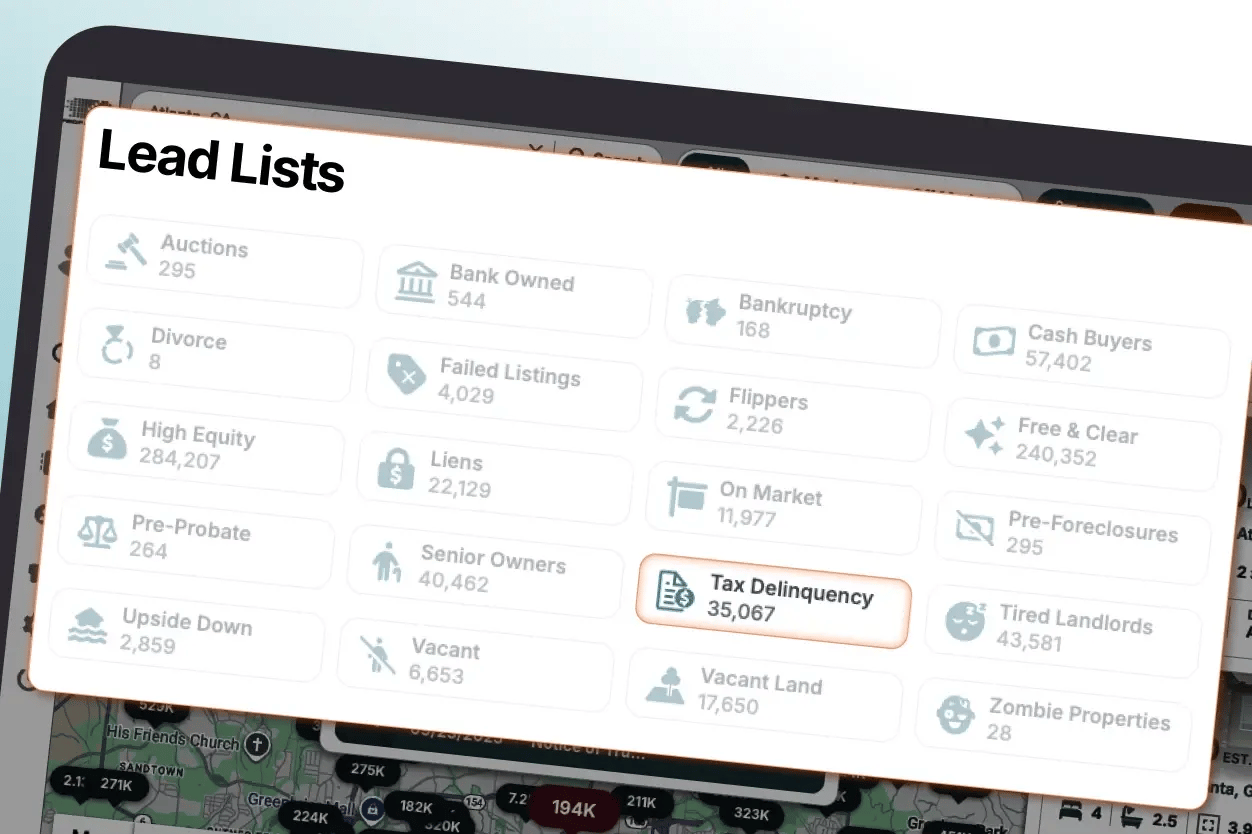
While you could scour public records for delinquent tax filings to find leads, there’s a better way.
PropStream lets you find tax-delinquent homeowners instantly with its dedicated search filter. Simply choose a market and apply the Tax Delinquency Lead List to isolate properties with back taxes. Also, PropStream offers the Lead Automator feature that automatically updates and notifies you as new tax-delinquent leads appear in your market if you set those parameters. That way, you won’t miss a beat reaching out to these prospects.
Either way, PropStream lets you bypass the manual research to find tax-delinquent leads faster.
But that’s not all. You can also stack additional filters to narrow your search, analyze individual properties’ investment potential, skip trace* owner contact information, and launch an email, postcard, or phone campaign to make offers—all within the same platform.
Given PropStream’s 160+ million property records, there are millions of tax-delinquent leads at your fingertips.
Pro Tip: Narrow your tax-delinquent property search further by applying specific tax delinquency years or year ranges.
Analyzing the Deal: Critical Tax Information at a Glance
Once you’ve identified a tax-delinquent property, you can dig deeper into the opportunity by selecting the Tax Information tab. It provides all of the following property details:
- Parcel number
- Tax year
- Tax amount
- Total assessed value
- Land value
- Improvement value
- Property taxes/tax assessment with the percentage change for each recorded year
These details can help you determine whether you’re interested in a property and how much you’re willing to offer.
Example Deal Analysis
For instance, imagine you find a tax-delinquent property with a value of $300,000 based on comparable properties nearby (aka comp value), but it has $10,000 in back taxes. This automatically adjusts the property’s value to $290,000 ($300,000 - $10,000).
Next, let’s say you plan to renovate the property after purchasing it. You estimate the renovation costs will be $50,000 and that the after-repair value (ARV) will be $450,000. Following the 70% rule, you decide to set your maximum offer price to $265,000 (0.7 x $450,000 - $50,000).
However, you don’t stop there. You also want to know what kind of return you can expect on your investment if you flip or rent out the property.
Fix-and-Flip Return Analysis
Assuming a $265,000 purchase price, $50,000 in renovations, $30,000 in transaction and holding costs, and a $450,000 resale price, your return on investment (ROI) would be 30.43%:
$450,000 - ($265,000 + $50,000 + $30,000) = $105,000
$105,000 / ($265,000 + $50,000 + $30,000) = 0.3043
Rental Return Analysis
Alternatively, let’s say you choose to rent out the property after acquisition and renovations.
Based on average market rents, you estimate the property can command $3,000 in monthly rent. Assuming you also expect $500 in monthly operating expenses (routine maintenance, tenant management, etc.), your net operating income (NOI) would be $2,500 ($3,000 - $500).
If your rent and operating expense estimates prove accurate, your cap rate (the property-level annual return) would be 6.67%:
$2,500 NOI x 12 = $30,000 Annual NOI
$30,000 annual NOI / Property Purchase Price = 0.066
Assuming you pay for the property with cash, your cash-on-cash return would also be 6.67%.
Ultimately, understanding the full picture of a tax-delinquent property before buying is essential to making a smart investment decision.
Making Compelling Offers on Tax-Delinquent Properties
Once you’ve narrowed down a tax-delinquent property to pursue, you must craft a compelling offer.
While tax-delinquent homeowners may not have much negotiation leverage, they still want to sell for the highest possible price. Here are a few things you can offer to sweeten the deal:
- Cash: A cash offer means fewer delays and complications from lenders.
- Earnest money: Earnest money is an upfront deposit that you forfeit if the deal falls through, showing the buyer you’re serious.
- A fast closing: Tax-delinquent property owners are on a tight deadline, making fast closings more appealing.
Sample Call Script
Of course, you’ll need to contact the tax-delinquent homeowner before you can make an offer. Here’s an example of an initial call script to follow:
[Opening - Warm and Professional]
“Hi [Owner Name], this is [Your Name] with [Your Company]. Do you have a minute?
[Purpose - Direct but Empathetic]
“I’m reaching out because I noticed your property at [Property Address] may have some unpaid taxes. I work with homeowners in situations like yours, and I wanted to see if you’d be open to a conversation about it.”
[Listen and Validate]
“I know dealing with back taxes can be stressful. A lot of homeowners I work with face unexpected financial challenges like losing a job, medical bills, that sort of thing. The good news is, you have options.”
[Present Solution]
“I invest in properties like yours, and I can make you a cash offer that would cover your back taxes, any penalties and interest, and put money in your pocket. No bank involvement, no waiting around.”
[Call to Action]
“Would it make sense to grab a few more details about your situation so I can put together a real offer for you? It’ll only take 10 minutes. What works better for you, later today or tomorrow?
[Closing]
“Great, I’ll call you back at [Confirm Number] at [Time]. Thanks [Owner Name], I look forward to working together.”
Sample Offer Letter
If the homeowner expresses interest, you can draft an official offer letter to send to them. Here’s a sample letter:
[Your Company Letterhead]
[Date]
[Owner Name]
[Property Address]
[City, State, ZIP]
RE: CASH PURCHASE OFFER – [Property Address]
Dear [Owner Name],
Thank you for taking the time to speak with me about your property. Based on our conversation and my analysis of the property, I am pleased to present the following cash purchase offer:
OFFER TERMS:
- Purchase Price: $[AMOUNT]
- Property Address: [Full Address]
- Earnest Money Deposit: $[AMOUNT] (held in escrow, applied to purchase price at closing)
- Proposed Closing Date: [DATE – typically 14-21 days]
- Financing: This is a cash offer with no contingencies for financing
WHAT THIS OFFER COVERS:
Your purchase price of $[AMOUNT] is designed to:
- Pay off all back taxes and penalties
- Cover accrued interest and fees
- Resolve your tax delinquency completely
- Provide you with net proceeds of $[NET AMOUNT] at closing
WHY THIS OFFER MAKES SENSE FOR YOU:
- Fast Close: You won’t have to wait months for bank approval. We close in [timeframe].
- No Complications: No appraisals, no inspections required on your end, no lender delays.
- Peace of Mind: Your tax debt is resolved, and you walk away with cash.
- Avoid Auction: You keep control of the process and the proceeds. No uncertainty.
NEXT STEPS:
If you’re interested in moving forward, please sign and return this letter by [DATE]. Once we receive your signature, I’ll connect you with my title company to begin the closing process.
If you have any questions or would like to discuss this offer, please don’t hesitate to call me at [PHONE NUMBER].
I look forward to helping you resolve this situation.
Sincerely,
[Your Name]
[Your Title]
[Your Company Name]
[Phone Number]
[Email Address]
| Note: This template should be customized based on your analysis of the property and your local market conditions. Additionally, always consult with a real estate attorney before sending formal offers to ensure compliance with local laws and regulations. |
Due Diligence Checklist: What to Verify Before Closing
Before committing to a tax-delinquent property, verify the following:
Post-Acquisition Investment Strategies

Buying a tax-delinquent property is one thing. Turning it into a profitable investment is another.
After doing your due diligence and finalizing the purchase, one of the first things you should do is ensure the delinquent taxes are paid off so that the property stops accruing interest and fees. You can do this by contacting the local county treasurer or tax assessor.
From there, decide whether to fix and flip the property or hold it as a rental. Returning to our previous example, here are the potential returns and timeline to profitability for both options:
Fix and Flip Path
Note: PropStream does not make promises regarding profit from certain investment strategies. These examples are used to compare the potential of flipping a property versus renting it out.
If you choose to flip the property, your timeline to profitability is relatively short, typically 6 to 12 months from acquisition to resale, depending on the amount of work needed.
This gives you an estimated annual return of 30.43% or higher. However, you must keep a few things in mind. First, this timeline assumes your renovation estimates are accurate, and the property sells quickly at or near your ARV. Delays in construction, unexpected repairs, or a slower real estate market can eat into your timeline and profit margins. Second, flipping requires active management. You must manage contractors, secure permits, and market the property.
The upside is that you tend to recover your capital quickly, which you can reinvest into your next deal. Many successful investors build momentum by completing multiple flips in a single year.
Rental Path
If you prefer a more passive, long-term wealth-building approach, holding the property as a rental may be the better option.
In our example scenario, you’d invest the same $265,000 purchase price, $50,000 in renovations, and $30,000 in transaction and holding costs into making the property ready for renters. However, instead of selling, you’d keep it and rent it out at $3,000 per month with $500 in monthly operating expenses.
This would generate $2,500 in net operating income (NOI), or $30,000 annually. Your cap rate on this investment is 6.67%, a solid return that many investors would be happy to accept.
But here’s where rentals shine: Your timeline to profitability extends beyond the first year. While your initial annual return may only be 6.67% (compared to 30.43% on a fix-and-flip strategy), you get to capture that 6.67% year after year, as long as you have tenants.
Plus, you can benefit from:
- Appreciation: Property values often rise 3.5-3.8% annually, though this varies by market. Over a ten-year hold, this can add significant compound returns to your investment.
- Rent growth: As the market appreciates, you can raise rents, which can increase your NOI and cap rate over time.
- Tax benefits: Depreciation, repairs, and operating expenses are often tax-deductible, reducing your taxable income.
In short, your total returns can potentially compound through both cash flow and appreciation over time, creating a more gradual but potentially more powerful wealth-building strategy.
Which Path Is Right for You?
The choice between flipping and renting depends on your investment goals, risk tolerance, and market conditions.
- Choose fix-and-flip if you need quick capital recovery, prefer active involvement, or are in a strong seller’s market where properties appreciate rapidly.
- Choose rental if you’re building long-term wealth, have capital to deploy across multiple properties, prefer passive income, or are in a stable or appreciating market.
Keep in mind that many successful investors do both. They flip some properties to generate quick cash and hold others for long-term appreciation and cash flow. The beauty of tax-delinquent deals is that they give you the flexibility to choose the strategy that works best for each property and your overall portfolio.
Scaling Your Tax-Delinquent Property Business
Once you’ve closed on your first tax-delinquent property, scaling to multiple deals requires building a reliable team and establishing repeatable processes.
Building Your Team
Build relationships with a real estate attorney experienced in tax delinquency, a title company that handles tax-delinquent closings, and contractors who can renovate properties. The best investors have a reliable team.
Funding Multiple Deals
Maintain cash reserves for carrying costs and consider partnering with a private or hard money lender. This can help you spread your capital across multiple properties instead of putting it all in one property.
Pro Tip: PropStream now offers a LoanGeek integration to help investors find funding sources. Learn more.
Systemizing Everything
Document your entire process: how you source leads, qualify them, conduct due diligence, craft offers, and complete closings. That way, you can train others to run through the process without you. Leverage real estate software like PropStream to automate manual tasks, too.
Diversifying Your Portfolio
Avoid concentrating your investments in one market or strategy. Instead, pursue deals in two or three markets, uncover different property types, and stagger acquisitions. This can help lower your overall investment risk.
Structure Your Business Properly
Consult a CPA or attorney about what legal structure (e.g., an LLC or S-corp) to use to protect your investments and optimize your taxes.
The key to sustainable scaling is patience. Avoid too much leverage, maintain your reputation, and keep learning. Investors who scale too fast often fail, but those who can scale methodically are the ones who tend to build lasting wealth.
How Tax-Delinquent Leads Compare to Other Lead Types
Compared to other lead types, tax-delinquent properties offer distinct advantages.
Deals tend to move faster than, say, probate property sales, which may have court-imposed timelines. And while the MLS offers more selection, buying a property listed on it often involves greater competition, narrowing profit margins.
Learn More in Our Free Academy Course: The Curious Records of Tax Delinquencies
Common Mistakes to Avoid

To maximize your returns on tax-delinquent properties, avoid these common pitfalls:
Ignoring Other Title Issues
A tax lien may not be the only lien on the property. Be sure to check for HOA liens, mechanic’s liens, and other encumbrances that could impact the deal.
Overpaying
You make your money when you buy. If the purchase price is too high, it can be very hard to make up for it later by increasing the property’s resale value or NOI.
Underestimating Costs
Some often overlooked costs include code violations that need to be resolved, deferred maintenance, and hidden damage that needs repair.
Neglecting Local Regulations
Not understanding local laws around tax deed sales, redemption periods, and foreclosure timelines can hamper your ability to pull off a successful investment.
Poor Communication Timing
Waiting too long to contact tax-delinquent homeowners or reaching out after the auction has already begun makes it harder to secure attractive profit margins.
Missing Deadlines
Tax delinquency notices, auctions, and redemption periods all come with important dates and deadlines. Missing one could cost you a deal.
Legal and Ethical Considerations
Tax-delinquent property investing is absolutely legal, but since it involves contacting homeowners in financial distress, there are some legal and ethical boundaries to maintain.
Know Your State’s Laws
Tax delinquency laws vary by state. Before reaching out to delinquent homeowners, research any disclosure rules, contact restrictions, or redemption periods your state may have. Consult a local legal professional to stay on the safe side.
Be Honest In Your Outreach
Homeowners deserve transparency. Disclose that you’re a real estate investor looking to profit, explain what the owner will net after taxes and liens, and provide realistic timelines.
Respect Homeowners’ Decisions
Tax-delinquent homeowners often face genuine financial hardship, so approach them with empathy and don’t pressure them into selling. This builds your reputation as an ethical investor.
Maintain Clear Records
Document all your communications, due diligence, and agreements in writing. This can help protect you later if disputes arise.
Find Your Next Tax-Delinquent Property with PropStream Today
Ultimately, tax-delinquent properties present a unique opportunity for real estate investors willing to do the necessary legwork. With rising delinquency rates and less competition than traditional deals, there is significant profit potential.
The key is acting quickly, before properties reach auction, and having a clear understanding of your state’s laws, conducting thorough due diligence, and being honest with homeowners. Find your next tax-delinquent property with PropStream today.
*PropStream engages an independent third-party to perform skip tracing.