


08.13.2026 PropStream
Disclaimer: PropStream does not offer investment or legal advice. This article is for informational purposes only. Consult a financial and/or legal professional before recommending real estate deals to investors.
|
Key Takeaways:
|
Every year, more agents jump into real estate, looking to make their mark. The problem is, today’s intense competition makes it harder than ever to succeed as a generalist. That’s why top agents zero in on a particular niche, attracting relevant leads by becoming the go-to expert.
That said, not all niches are created equal. Strategic agents decide how to specialize based on where they can find:
- High, consistent sales volume
- High commissions per sale
- Manageable competition
- Ease of earning referrals and repeat business
Based on those criteria, we’ve gathered some of the most profitable niches for real estate agents below.
Note: Becoming a specialist doesn’t have to limit you. It’s common to adopt multiple niches, especially when clientele overlaps. For example, you might focus on fix-and-flips, buy-and-holds, and self-storage since these tend to attract individual investors.
Table of Contents |
Residential Real Estate Niches
Even when the market cools, there are always people trying to buy a home of their own. Last year, 4.06 million previously owned homes were sold across the U.S., making residential real estate a hot market. 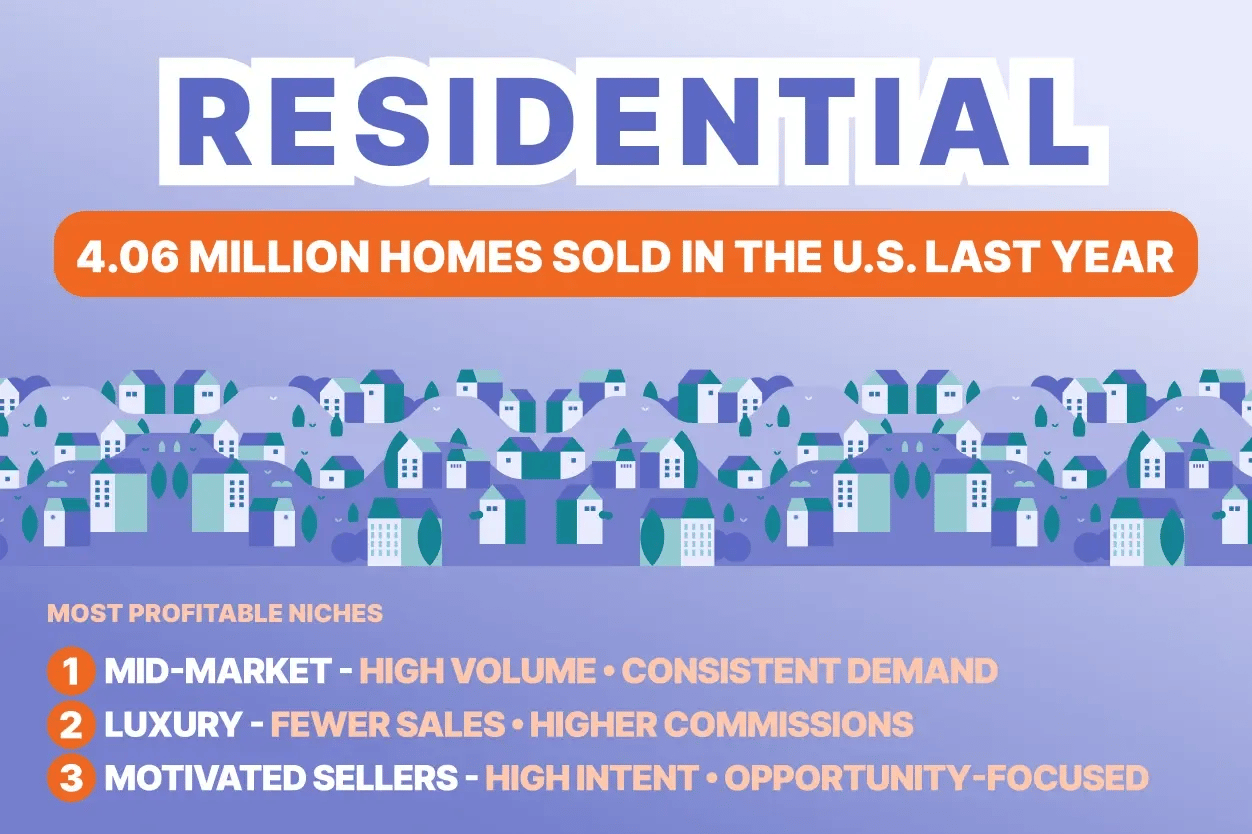
Some of the most lucrative residential niches include:
1. Mid-Market Homes
Mid-market properties generate greater sales volume than luxury real estate, yet higher commissions than entry-level properties.
Single-family homes, especially those in established, owner-occupied neighborhoods, are always in demand, as are mid-market co-ops and condos in metropolitan areas.
2. Luxury Homes
High-end or ultra-luxury houses may not sell as quickly as mid-market real estate, but the earnings per transaction are higher. Selling as few as 5 properties per year can provide enough income for some agents.
With luxury real estate, how you present yourself is key; attracting wealthy clients doesn’t allow much room for skimping on your marketing efforts.
3. Distressed or Motivated Sellers
Most agents market to a particular geographic area, not to a specific type of seller, making it easier for you to stand apart if you choose this route.
Targeting sellers facing certain life stages or financial situations allows you to focus on leads who are more likely to need your help, such as:
- Tired landlords
- Downsizing seniors
- Vacant homeowners
- Divorcees
- Homeowners in pre-probate
- Owners facing pre-foreclosure
- Sellers with expired listings
Investor-Focused Niches
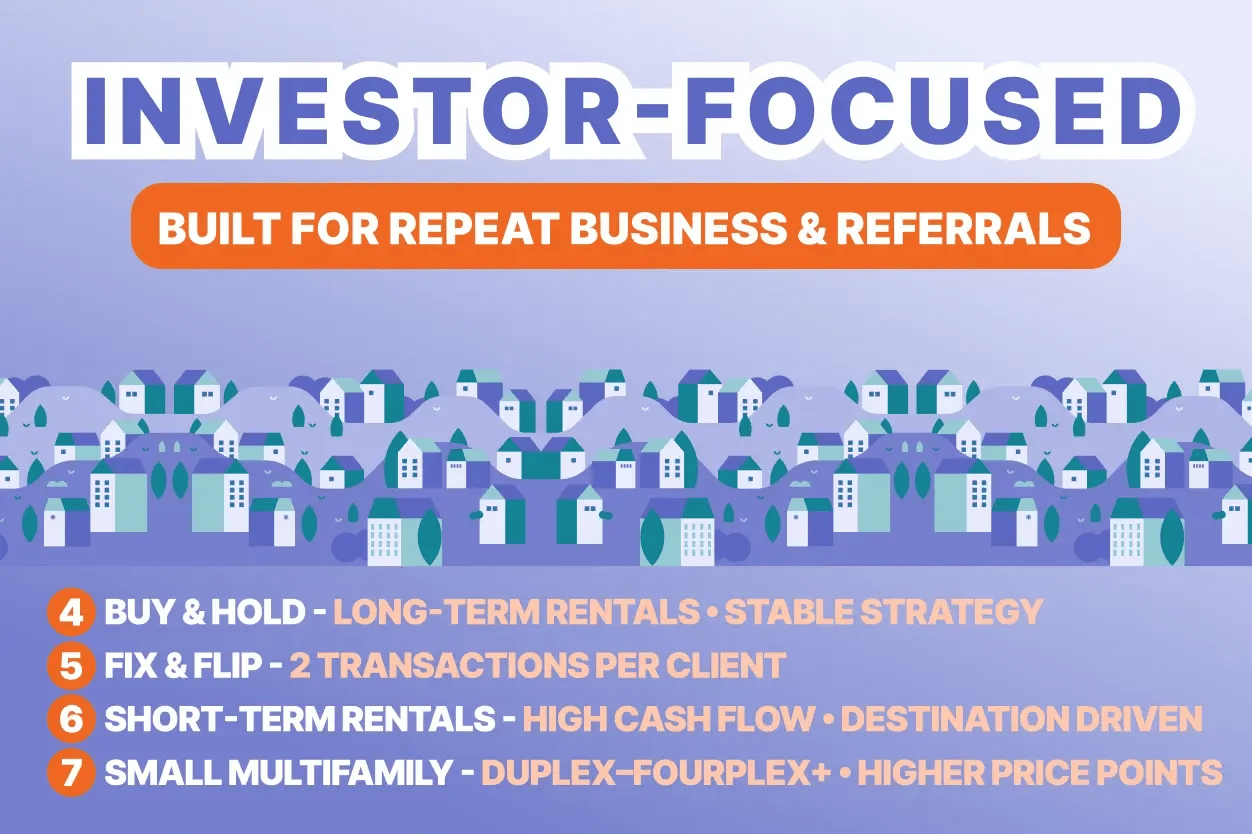
It’s not uncommon for investors to buy and sell multiple properties within the same year, making them an excellent source of repeat business. They also tend to be a well-connected group, which is ideal for referrals.
The following niches work best in rental-heavy areas, primarily when agents focus on homes of median or slightly below median value.
4. Buy-and-Holds
Despite market cooldowns, buy-and-holds remain one of the most popular real estate investment strategies. Many first-time investors start with long-term rentals and are looking for an experienced agent to guide them through the process.
5. Fix-and-Flips
Buying a home, fixing it up, and selling it at a higher price is a common investment tactic, representing around 7% of total home sales in the U.S. This method also gives agents two transactions per client—buying the property, then selling it after the investor has made improvements.
6. Vacation and Short-Term Rentals
Sites like Vrbo and Airbnb have helped turn short-term rentals (STR) into a booming corner of the real estate market. Plus, STR investors like to collect properties in the same area, making them an engine for repeat business.
This niche is most effective in popular destination areas, such as mountains, beaches, or theme-park cities.
7. Small Multifamily
“Small multifamily” usually refers to duplexes, triplexes, and fourplexes, but some use the label to encompass any building with up to 50 units.
These transactions tend to be less complex than those for large multifamily buildings, but they still carry a higher price tag than single-family rentals.
Commercial Real Estate Niches
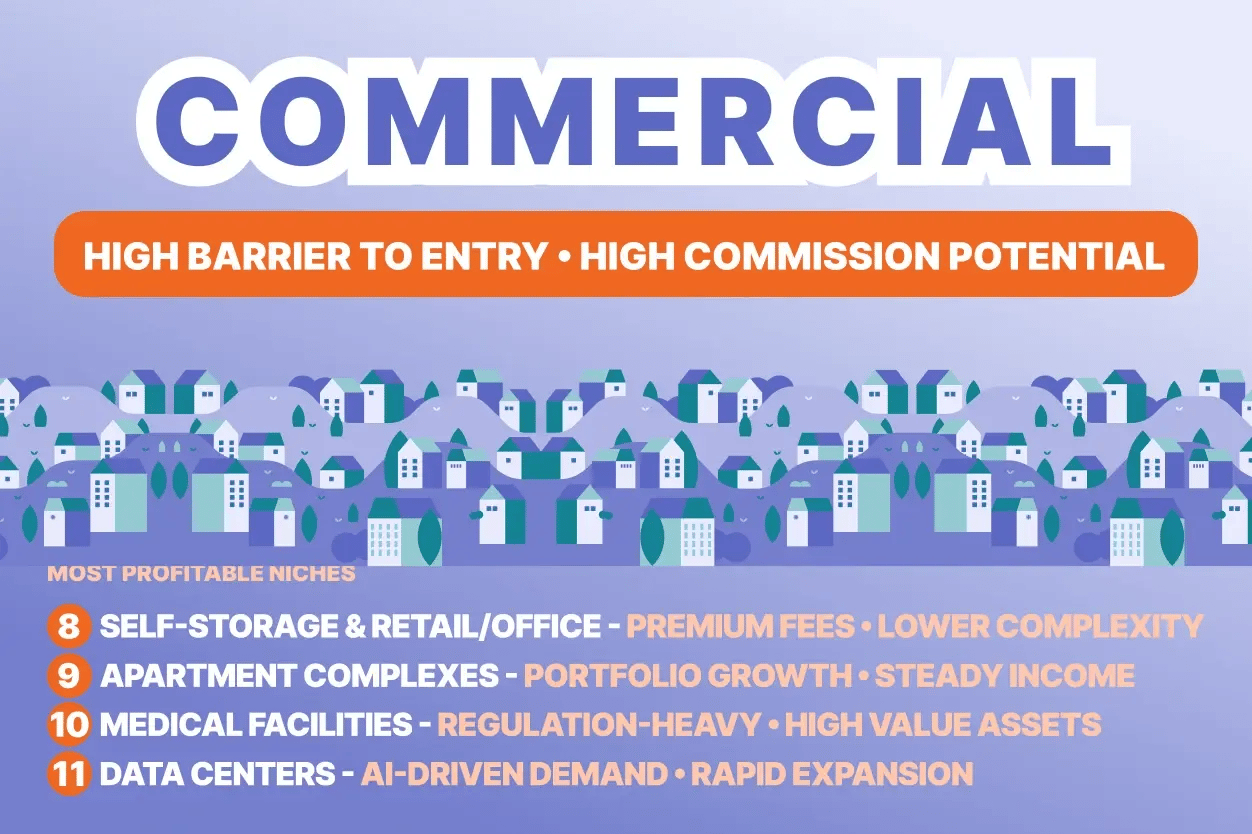
The substantial commissions that come with commercial real estate make it a desirable specialization. And the additional training, experience, or financial knowledge it requires helps keep competition low.
If you’re willing to put in the work and perhaps earn extra credentials, the following niches are worth considering:
8. Self-Storage and Retail/Office
These property types command premium commissions but are less complex than larger commercial buildings. They also tend to attract small companies and investors, who are often easier to reach—and work with—than developers or large corporations, especially for solo agents or small teams.
9. Apartment Complexes
A third of all rentals are in large multifamily buildings, which means this niche outperformed single-family rentals in 2025. Whether you’re working with developers or investors with growing portfolios, these relationships lend themselves to steady income.
10. Medical Facilities
As the U.S. population ages, the need for new hospitals, doctors’ offices, and medical outpatient facilities is steadily rising.
To succeed in this niche, agents should learn the relevant zoning laws, building codes, and healthcare and environmental regulations. That said, medical buildings cost anywhere from tens to hundreds of millions of dollars, which means your specialized knowledge is well-rewarded.
11. Data Centers
Thanks to AI, cloud computing, and the digitization of governmental services, demand for data centers is expected to triple by 2030.
This fast-growing niche requires specialized knowledge, but agents who successfully establish themselves as experts can reap generous profits.
How to Choose Your Niche
The profitability of any given niche depends on many factors, including competition, local market conditions, and agents’ unique skills and experience.
Here’s how to choose the niche that’s right for you and make the most of it.
1. Research Property Data
Before diving into any niche, be sure to research it thoroughly to reduce risk and create a realistic marketing plan.
To assess buyer demand and profitability, agents should analyze:
- Inventory levels
- Pricing trends
- Turnover
- Days on market
- Sales volume
- Sale-to-list ratio
Using real estate data software like PropStream allows agents to research these market trends within specific zip codes.
Check out the Ultimate Guide to Getting Started with PropStream to learn how to use property data to find and evaluate opportunities across any niche.
PropStream Academy is free to use and features a growing library of value-packed courses designed to help you get more from your data.
2. Gather High-Intent Leads
Once you’ve identified your niche (or niches), you can identify relevant properties and owners with PropStream’s 165+ search filters, including:
- Property type
- Home value
- Length of ownership
- Foreclosure/Pre-foreclosure
- Probate
- Divorce and more
3. Make Your Outreach Memorable
Once you have identified your niche and built your list, the next step is meaningful outreach.
Instead of sending generic messages, add real value to every interaction. Share accurate comps, highlight local pricing trends, or reference recent neighborhood activity. PropStream makes it easy to pull this data quickly, helping you demonstrate expertise from the very first touchpoint.
You can reach prospects directly within PropStream using multiple outreach options:
- Use Click-to-Dial to instantly call leads within PropStream using the built-in softphone.
- Set up an email campaign to stay top of mind with comp details and offer.
- Send a Postcard on the go with PropStream mobile marketing for consistent physical touchpoints.
Click-to-Dial is especially powerful for niche targeting. It allows you to contact high-intent leads immediately while the data is still in front of you. That means no exporting lists, no switching platforms, and no delay between research and action. You move from insight to conversation in seconds.
*PropStream engages an independent third party to perform skip-tracing.