11.9.2026 PropStream
Disclaimer: PropStream does not offer legal advice. This article is for informational purposes only. We recommend conducting your own research or consulting legal professionals before contacting motivated sellers.
AI can help agents write content, research properties, and prepare for client conversations. But with so many ways to use it, deciding where to start can feel like another task on an already full calendar.
With more than 20 years in real estate, broker Eddie Arguelles has seen technology change how agents do business. We asked him what the recent rise of AI means for agents and where he sees the most practical opportunities to put it to work.
About Eddie: Eddie Arguelles is a Florida real estate broker with more than two decades of experience spanning nearly every side of the residential real estate business. He began his career in the competitive Chicago market before relocating to Florida, where his roles have included agent, broker-owner, team leader, recruiter, trainer, and mentor. He previously co-led a successful independent brokerage in Stuart that later became Engel & Völkers Stuart, where he served as a License Partner and Director of Growth. Today, Eddie leads InfluenceRe Real Estate and serves as a Product and Content Specialist at PropStream, bringing the perspective of someone who has built businesses, led agents, and worked through multiple generations of change in real estate.
In these 10 questions, Eddie shares his take on practical AI uses, common mistakes, and why an agent’s judgment still matters as real estate information becomes easier to access.
|
Key Takeaways:
|
What Are the Most Practical Ways Agents Should Be Using AI in 2026?

Practical is the keyword.
For most agents, the most practical place to start is marketing and content ideation. Using AI to generate newsletter topics, email campaigns, and social posts that speak to a specific audience.
That audience might be a neighborhood, homeowners in a particular situation, or people with a specific motivation to move. Where it really works is when you feed it your own market analysis and opinion on what’s happening locally.
AI gives you the volume; your perspective is what makes it worth reading.
How Can Agents Use AI to Research Properties, Homeowners, and Local Markets More Efficiently?
The biggest shift is that research is now conversational.
Instead of building filters and scrolling through lists, you can ask plain-English questions of a tool connected to a strong data source.
That might mean asking where seller distress is showing up for a particular lead or which owners are showing signs of life changes that could signal a potential move, and letting AI help surface opportunities for further research.
Tools like PropStream Intelligence Assistant & AI Search bring that conversational approach to property research.
That cuts the time between research and a meaningful conversation with an owner who may actually need your help.
How Can AI Help Agents Identify Potential Listing Opportunities or Prioritize Who to Contact?
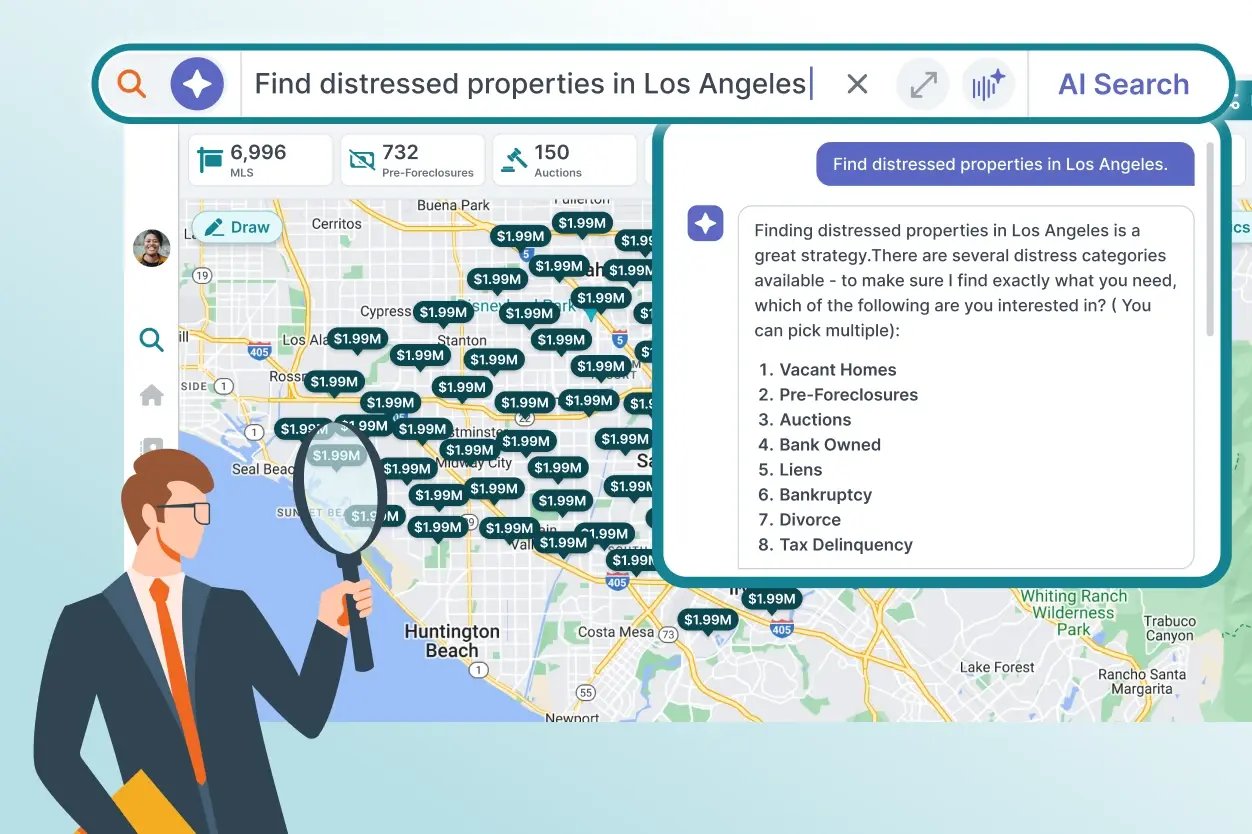
AI is great at combing through property data to spot which owners may be most motivated to sell. That can include signals like liens, late property taxes, or owing more on the mortgage than the home is worth (AKA underwater or upside-down).
One signal on its own doesn’t tell you much. The real value comes from stacking them.
The better you get at combining those filters, the narrower and more focused your list becomes. That means you’re reaching out to the owners most likely to need help first, instead of working a cold list from top to bottom.
Pro Tip: Use PropStream’s AI Search to describe multiple criteria in one request, such as “Show me vacant properties with out-of-state owners in Tampa.” It’s a simpler way to combine criteria and build a focused list, which you can review and refine before starting your outreach.
What Makes AI-Assisted Communication Still Feel Personal and Authentic to a Client?
The key is context.
When you reach out, your message should make it clear why you’re the right person for that owner’s specific situation. Ideally, that’s because you’ve helped people in the same position before. You have relevant experience to bring to the conversation.
AI can give you quick talking points and a solid first draft. AI-guided scripts in tools like PropStream’s Click-to-Dial can also help you prepare what to say.
But you still have to listen, respond to what the owner is sharing, and bring your own experience to the conversation. That human touch is what turns outreach into a real connection with the client.
Related Read: 4 Ways to Get the Most Out of Click-to-Dial and Dialer Campaigns
What Are Some of the Biggest Mistakes Agents Make With AI?
The biggest mistake I see is treating AI as a shortcut rather than a tool.
Too many agents send broad, generic messages that could have gone to anyone. Or they type a one-line prompt and expect AI to read their minds.
Better prompts get better results. Give it context about who you’re speaking to, what you want to communicate, and what you know about the situation.
And even though AI has come a long way, you still have to verify what it tells you. It can sound confident and still be wrong.
How Can Experienced Agents Use AI Without Losing the Expertise and Relationships That Differentiate Them?

Think of AI as a very smart assistant built into your workflow, not a replacement for you.
When someone is making what’s likely the largest financial decision of their life, they want a human they trust on the other side of the table.
Your experience and the relationships you’ve built still matter.
I think the best way for experienced agents to use AI is to gather information faster, make sharper decisions, and spend more time actually serving clients.
As AI Makes Information Easier to Access, Where Does an Agent’s Expertise Become More Valuable?
AI can put information in anyone’s hands, but it can’t sit across from a nervous seller and guide them through the process.
To me, an agent’s expertise matters most in the moments that call for judgment. That means interpreting what the data really means for that client, negotiating on their behalf, and managing the expectations and emotions that come with a major transaction.
Clients may arrive better informed than ever. But they still count on their agent’s local knowledge and steady hand to get them to the closing table.
What AI Capabilities Could Have the Biggest Impact on Agents Over the Next Few Years?
I think AI is going to make the whole process more streamlined and simpler for agents and clients alike.
We’re already seeing natural-language property search. I think we’ll also see AI help consumers find the right agent for their specific situation and local market.
The biggest impact will come as it reaches the transaction itself, verifying data and helping move deals to closing.
The tools that win will cover the full cycle: Search, Identify, Connect, and Transact.
If an Agent Has Barely Used AI, What Should They Start With?
Start by just talking to any AI tool out there, and don’t worry about getting the question perfect. Treat it like a conversation with someone in the room.
If you’re unsure what details to share, ask, “What do you need to know from me to make this more useful?” That can help you move the conversation forward without having to figure out the perfect prompt.
Next, teach it who you are: your goals, your business, your style, and the markets you serve.
Then give it examples of your past work so it can better understand how you communicate.
The more familiar it is with your voice and the context you provide, the more it can help you create something that feels genuine instead of generic.
What Is Your One Rule for Agents Using AI Effectively in 2026?

My one rule: let AI draft, optimize, and analyze, but never let it hit Send or Publish without your human stamp of approval.
That approval should include your own due diligence. Check the facts, verify property information, and question the assumptions behind any analysis before using it to guide a client. A confident answer from AI isn’t a substitute for doing your homework.
Within that guardrail, make it part of your daily routine, personally and professionally. The more comfortable you get with it, the more proficient you’ll become.
The technology is moving fast, and it isn’t going away, so don’t get overwhelmed.
Just do your best to stay in step.
Put AI to Work With Your Expertise Leading the Way
One theme runs throughout Eddie’s advice: AI is most useful when your experience gives it direction. Knowing your market, asking thoughtful questions, and reviewing the results are what turn information into something you can use.
PropStream Intelligence helps bring that approach into your property research. Use AI Search to find properties using everyday language, then ask the PSI Assistant property-specific questions to explore opportunities and support your analysis. Pair that research with your local knowledge to prepare for more informed conversations with owners and clients.
As Eddie reminds us, getting comfortable with AI takes practice. Start with a task that matters to your business, build it into your routine, and keep your judgment at the center.