

01.8.2026 PropStream
Disclaimer: PropStream does not offer financial advice. This article is for informational purposes only. Do your own research and consult a financial professional before investing in real estate based on vacancy rate trends.
|
Key Takeaways:
|
As a real estate investor, high vacancy rates can signal an oversupply of housing, low demand, or both. However, it can also be an opportune time to buy property at a discount.
In this article, we’ll explore the states with the highest vacancy rates, what this means for investors, and how you can use this data to analyze markets and make better deals.
Table of Contents |
Why Vacancy Rates Matter for Rental Investors
Vacancy rate is the percentage of available housing units in a market that are unoccupied. For example, if a market has 100,000 housing units and 10,000 are empty, the vacancy rate would be 10% (10,000 / 100,000).
Keep in mind that some level of vacancy in a housing market is normal, e.g., from rental turnovers and home sales. As a result, a healthy vacancy rate is typically between 5% and 8%. Anything below this range indicates a tight market, while anything above could indicate an oversupply of housing units or flagging demand.
When high vacancy rates persist, they could impact the cash flow, returns, and long-term value of a rental property. Of course, this applies more to buy-and-hold investments (which rely on occupancy for rental income) than short-term flips.
That said, high vacancy rates don’t necessarily mean it’s a “bad market.” It just means you need to dig deeper into the numbers to ensure the market aligns with your investment strategy.
Also read: Short-Term Rentals vs. Long-Term Rentals: Which Is Right For You?
Understanding What “Vacant” Really Means in the Data
The U.S. Census Bureau distinguishes between two types of vacancy rates:
Rental vacancy rate is the proportion of a market’s rental inventory that is vacant for rent, while homeowner vacancy rate is the proportion of homeowner inventory that is vacant for sale.
Moreover, vacancies can be categorized even further into the following:
|
Seasonal vacancies |
Properties intentionally kept for periodic use rather than year-round occupancy, such as vacation and snowbird homes. |
|
Transitional vacancies |
Short-term gaps between tenants that occur during normal rental turnover, typically lasting a few weeks to a couple of months. |
|
True long-term vacancies |
Properties that remain unoccupied for extended periods due to their poor condition, the market, or other reasons. |
Understanding different types of vacancies can help you understand why some markets have higher vacancy rates than others. For example, vacancy rates in states with heavy seasonal housing (e.g., Maine, Vermont, Alaska, Florida) tend to skew higher due to seasonal vacancies.
The National Vacancy Snapshot
To gauge different vacancy rates, it helps to use the national average as a benchmark.
According to the U.S. Census Bureau 2023 American Community Survey (ACS), the U.S. vacancy rate is 10.43% (this includes rental and homeowner vacancies).
Interestingly, vacancy rates declined slightly from 2022 to 2023, partly due to higher mortgage rates discouraging homebuying and thus reducing household turnover.
10 States with the Highest Vacancy Rates
Now that you understand vacancy, let’s explore the U.S. states with the highest vacancy rates.
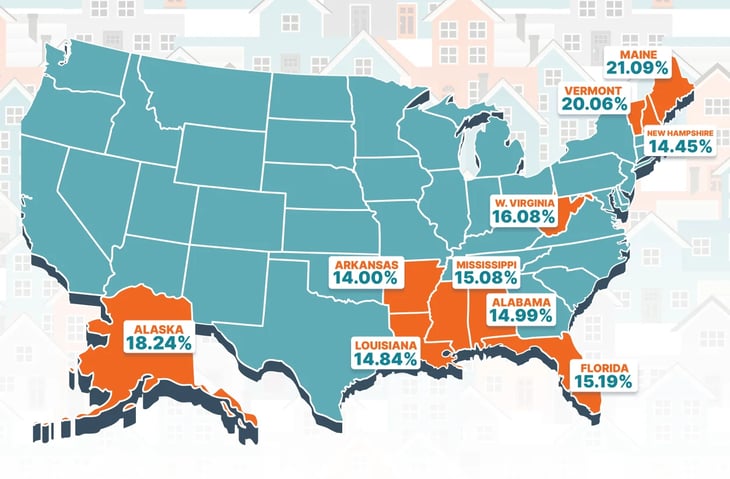
High-Vacancy Markets to Know
Maine
|
Vacancy rate |
21.09% |
|
Total housing units |
746,552 |
|
Median home value |
$266,400 |
Maine’s exceptionally high vacancy rate may be driven partly by seasonal properties along its extensive coastline and lake regions. As a result, investors may want to focus on short-term rental strategies.
Vermont
|
Vacancy rate |
20.06% |
|
Total housing units |
337,072 |
|
Median home value |
$290,500 |
Vermont’s high vacancy rate may partly reflect its robust ski resort and second-home market. Consider capitalizing on this by investing in short-term rentals near ski resorts.
Alaska
|
Vacancy rate |
18.24% |
|
Total housing units |
327,610 |
|
Median home value |
$333,300 |
Alaska’s high vacancy rate may be partly influenced by seasonal employment patterns in industries like fishing, tourism, and oil. Target homes near industrial and military sites for the best returns.
West Virginia
|
Vacancy rate |
16.08% |
|
Total housing units |
859,653 |
|
Median home value |
$155,600 |
West Virginia’s high vacancy rate may stem from population decline. However, its low median home value presents opportunities for getting into the market at a low price.
Florida
|
Vacancy rate |
15.19% |
|
Total housing units |
10,082,356 |
|
Median home value |
$325,000 |
Florida’s high vacancy rate may be influenced by seasonal snowbird properties and vacation homes, particularly in coastal and resort markets. Despite this, major metros like Tampa and Orlando still have strong rental demand for long-term rentals.
Mississippi
|
Vacancy rate |
15.08% |
|
Total housing units |
1,332,811 |
|
Median home value |
$161,400 |
Mississippi’s high vacancy rate may reflect economic headwinds and slower population growth, but the state’s low median home value may present unique buying opportunities.
Alabama
|
Vacancy rate |
14.99% |
|
Total housing units |
2,316,192 |
|
Median home value |
$195,100 |
Alabama’s high vacancy rate may mask pockets of strong growth in metros like Huntsville and Mobile. By finding an affordable entry point, you could secure a property that appreciates.
Louisiana
|
Vacancy rate |
14.84% |
|
Total housing units |
2,094,002 |
|
Median home value |
$208,700 |
Louisiana’s high vacancy rate may be partly due to hurricane-related displacement. Before investing, carefully assess flood zones and insurance costs, but don’t ignore short-term rental opportunities in tourist-heavy New Orleans.
New Hampshire
|
Vacancy rate |
14.45% |
|
Total housing units |
644,253 |
|
Median home value |
$367,200 |
New Hampshire’s high vacancy rate may be driven partly by vacation homes in the White Mountains and Lake Regions, similar to Vermont. Despite this, the state’s strong economy and proximity to Boston can make it an attractive market.
Arkansas
|
Vacancy rate |
14.00% |
|
Total housing units |
1,382,664 |
|
Median home value |
$175,300 |
While Arkansas has a high vacancy rate, it also offers some of the most affordable entry points for real estate investors, even for those investing from out of state.
Why Some Low-Vacancy States Still Have More Empty Homes
A high vacancy rate just means there is a high level of vacancies relative to the number of available housing units. Markets with lower vacancy rates may still have more total vacant units.
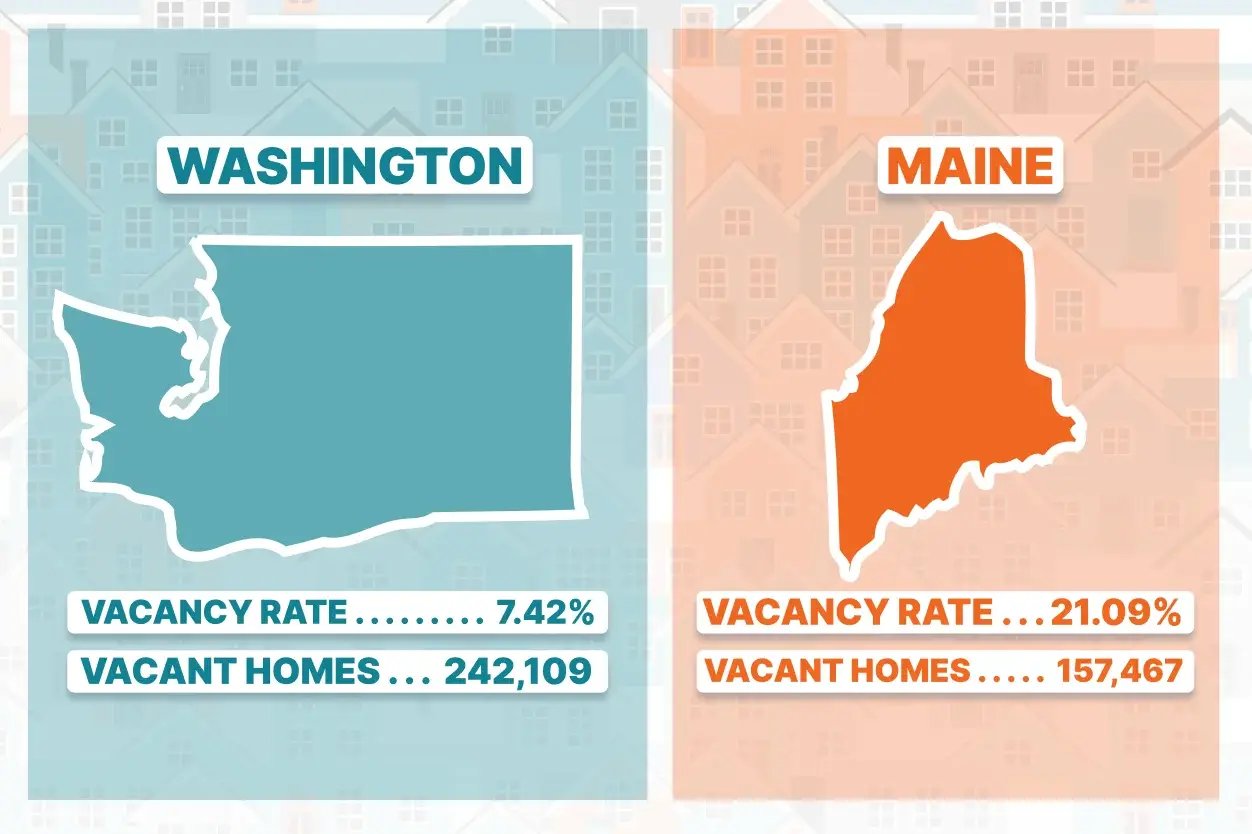
For example, although Washington has the lowest vacancy rate (7.42%), its total number of vacant homes (242,109) is significantly higher than that of Maine (157,467), which has the highest vacancy rate (21.09%).
Another way to explain this is that major markets’ high population density, job centers, and sustained rental demand help offset vacancies, pushing their overall vacancy rate down.
What High Vacancy Rates Signal for Buy-and-Hold Investors
For buy and hold investors, high vacancy rates can be a potential warning sign, but they can also open the door to opportunities.
What matters most is the source of the vacancy. Buy-and-hold investors should evaluate whether vacancies are driven by temporary or structural factors by asking:
- Is the vacancy seasonal or persistent year-round?
- Are jobs and population moving into or out of the area?
- Are rents stable or trending upward despite vacancies?
- Are vacant properties clustered due to condition, age, or ownership type?
Ultimately, the right question is not whether a vacancy exists, but whether the cause of the vacancy aligns with a long-term buy and hold strategy.
Pro Tip: Vacancy tied to turnover, seasonality, or deferred maintenance can often be corrected through pricing, renovations, or improved management.
How Investors Should Use Vacancy Data (and What to Avoid)
Statewide vacancy data should be used as a starting point, not a final decision factor. It helps identify markets worth deeper analysis, but does not replace local research.
Once a state stands out, investors should narrow their focus to cities, ZIP codes, and neighborhoods to understand where vacancies are concentrated and why they exist. In many cases, higher vacancy levels are tied to seasonal housing, short-term rental zones, or normal market turnover rather than weak demand.
|
Vacancy data is most valuable when paired with additional indicators such as:
Investors should avoid relying solely on:
|
High vacancy can represent an opportunity when the cause aligns with your investment strategy. The goal is not to avoid vacancy entirely, but to understand its source and assess whether the risk is justified by the potential return.
How PropStream Helps Investors Evaluate Vacancy Risk
Turning vacancy data into investable insight requires property-level intelligence, and that’s where PropStream comes in.
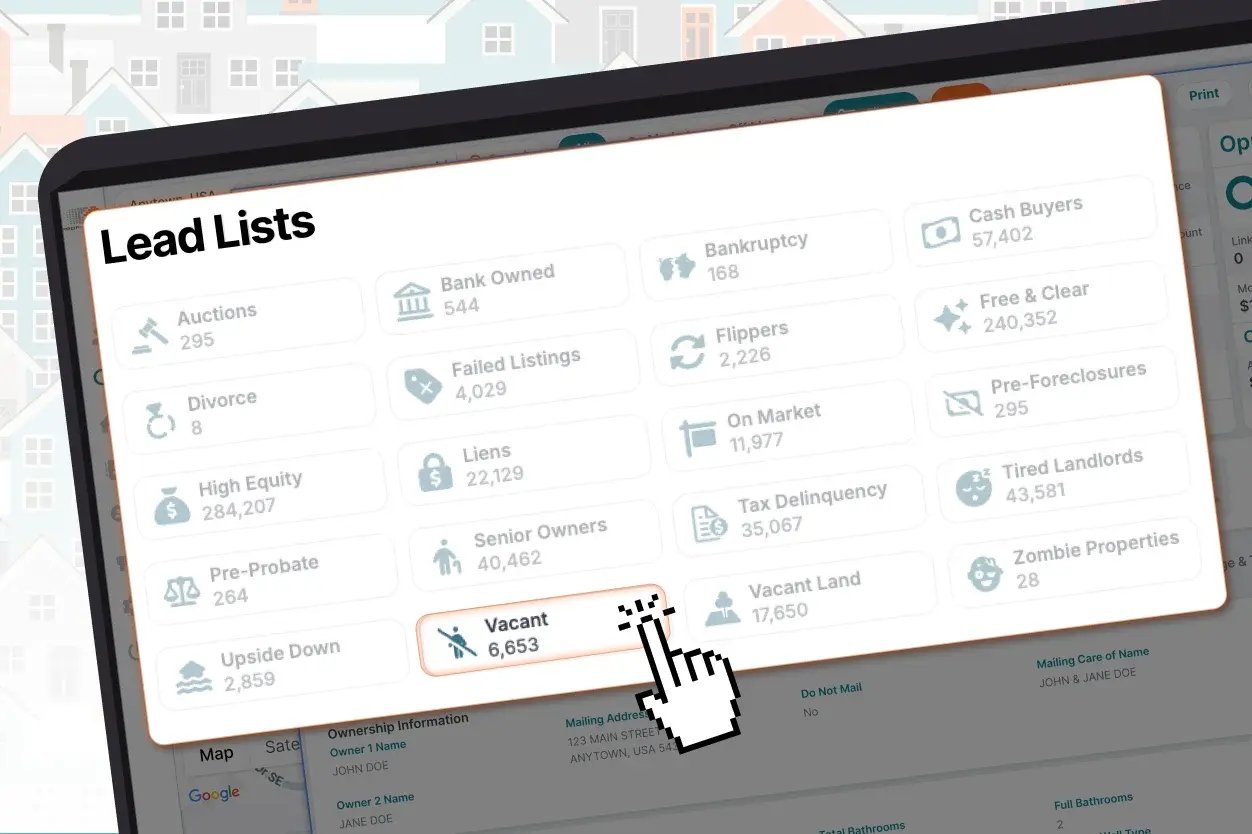
PropStream offers a dedicated Vacant Lead List, enabling investors to identify properties that are neither owner-occupied nor actively occupied quickly, along with evaluating the property condition. More importantly, vacancy status can be combined with other high-intent filters to separate distressed opportunities from long-term risk.
With PropStream, investors can:
- Start with the Vacant Property lead list to locate unoccupied homes
- Layer in ownership filters (e.g., absentee owners, years of ownership)
- Stack financial signals like high equity or free-and-clear status
- Add distress indicators such as pre-foreclosure, tax delinquency, or tired landlords
- Drill down by city, ZIP code, or neighborhood to evaluate local demand dynamics
This layered approach helps investors distinguish between:
- Properties vacant due to transition or deferred maintenance (potential opportunity)
- Properties vacant due to structural market decline (higher risk)
Ultimately, vacancy rates tell a story, but only when paired with the correct data.
By utilizing PropStream’s vacancy lead list and property insights, buy and hold investors can validate their assumptions, mitigate risk, and focus on opportunities supported by genuine market signals and not just averages.