
09.9.2026 PropStream
Disclaimer: PropStream does not offer legal advice. This article is for informational purposes only. We recommend conducting your own research or consulting legal professionals before disposing of a real estate property.
| Quick Answer: A real estate disposition is the final step in the property investment life cycle. It’s the act of selling, transferring, or otherwise parting with a property. |
Imagine finding the ideal rental property: the location is unbeatable, the numbers align seamlessly, and you’re ready to bring your real estate investment goals to life.
Yet, one critical phase often gets overlooked: disposition.
As the final step in the investment life cycle, disposition involves selling, transferring, or offloading the property to capture its full value.
Planning your exit before even closing on a purchase might seem counterintuitive. However, establishing a clear disposition strategy from the start is essential for optimizing long-term returns and scaling your portfolio effectively.
In this guide, we’ll break down real estate dispositions—exploring key concepts, practical examples, and proven strategies for success. Let’s dive in.
|
Key Takeaways:
|
Real Estate Disposition Definition
In real estate, disposition is the act of selling, transferring, or otherwise parting with a property. It’s often done to capture equity gains, reallocate funds into other investments, or rebalance a property portfolio.
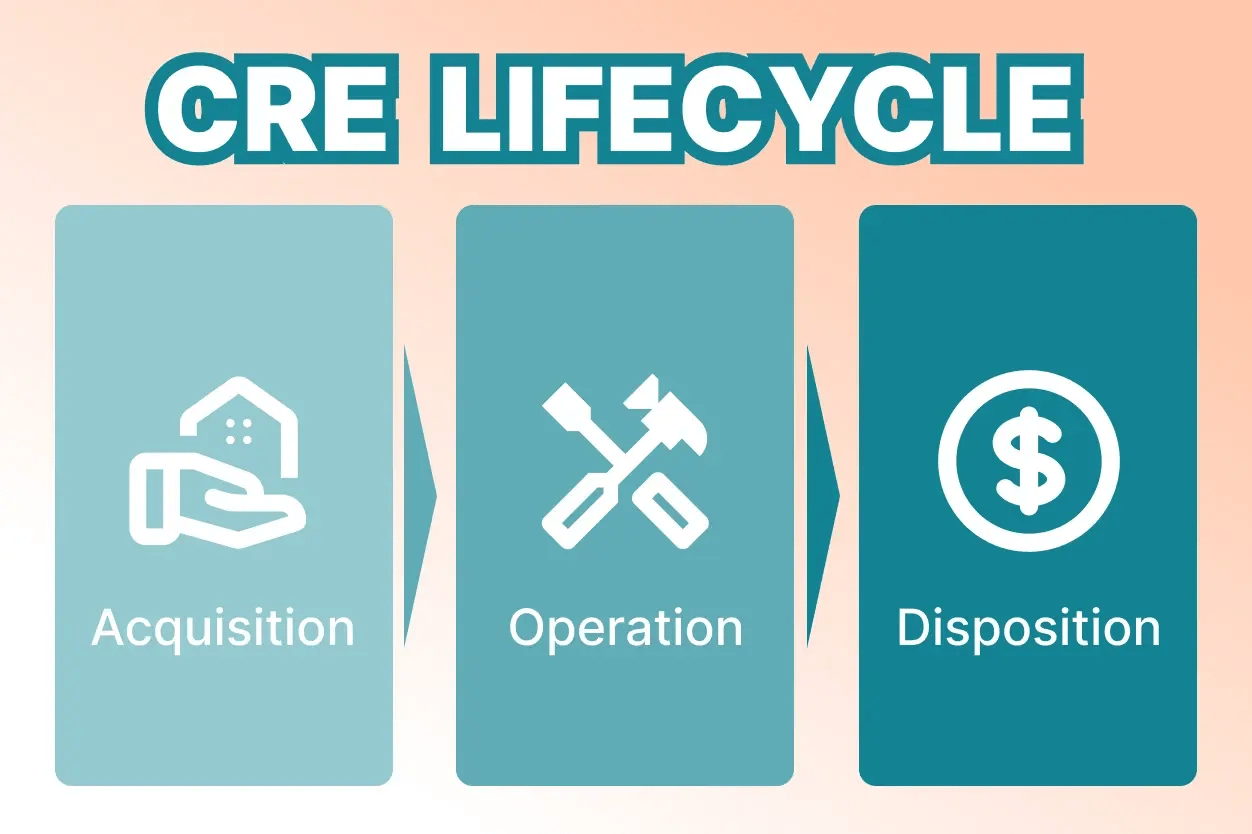
Keep in mind that the term disposition is most commonly used in commercial real estate (CRE), where it represents the final phase of the CRE life cycle:
Acquisition → Operation → Disposition
First, you buy a property, then you manage it, and finally, you sell it. Of course, investment strategies and timelines can vary, but most follow this pattern, with disposition as the last step.
Acquisition vs. Disposition: What’s the Difference?
To better understand dispositions, let’s contrast them with acquisitions:
| Acquisition | Disposition | |
| Definition | The process of purchasing or acquiring a property | The process of selling, transferring, or otherwise parting with a property |
| Stage in Life Cycle | First stage | Final stage |
| Primary Goal | Build or grow a real estate portfolio | Capture equity gains, reallocate capital, or rebalance a portfolio |
| Financial Focus | Securing funding, minimizing purchase costs | Maximizing sale price, minimizing tax liability |
| Risks | Overpaying, poor property condition, bad location | Selling below market value, timing the market poorly |
Example Real Estate Disposition Scenarios
Consider the following real-life disposition scenarios:
Fix-and-Flip Disposition
Imagine you buy a distressed property in poor condition. To bring the property back to a marketable condition, you renovate it. Then, once the rehab is complete, you list it for sale to capture a return on investment. Ideally, the sale proceeds exceed your upfront costs.
For example, say the property cost $100,000, and you put in $50,000 in renovations and $5,000 in holding costs for a total outlay of $155,000. Then you sell it for $200,000. This would mean you capture $45,000 in profit ($200,000 - $155,000) for a return of 29% ($45,000 / $155,000).
Rental Property Disposition
Next, imagine you buy a rental property and hold onto it. After ten years, you decide to sell to capture the appreciation gains. You list the property for sale and find a buyer who is willing to pay your asking price.
Let’s say you bought the rental property for $200,000 and sold it for $400,000. That’s a $200,000 profit ($400,000 - $200,000) and a 100% return ($200,000 / $200,000) over a ten-year period.
How to Execute a Successful Real Estate Disposition
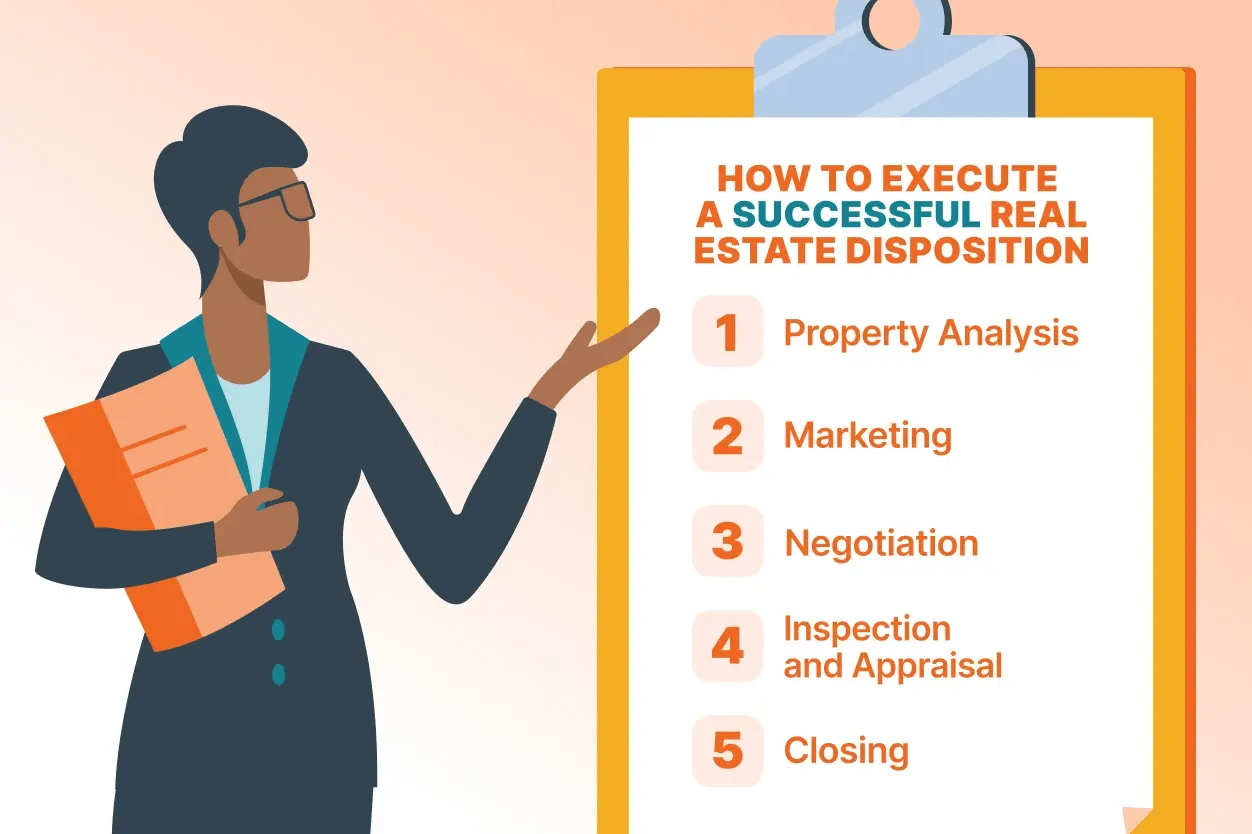
To execute a real estate disposition, consider these steps:
Property Analysis
First, analyze the property and the local market to determine its value.
This can involve averaging the values of nearby properties with similar properties that recently sold (aka “comps”), multiplying the property’s net operating income (NOI) by an average cap rate, or using another valuation method.
Marketing
Next, list the property for sale with an agent and start your outreach.
This means putting it on the multiple listing service (MLS), where other buyer agents can see it. But don’t stop there. Advertise on other online marketplaces, host open houses, and put out “for sale” signs. The more exposure the house gets, the more potential demand it can generate and the higher price it can command.
Pro Tip: Want to save on agent commissions? Consider getting your real estate license and facilitating your own transactions. Learn more in this article: Should Real Estate Investors Have a License?
In addition to listing the property, consider starting a marketing campaign to entice buyers directly while the listing generates organic traffic in the background.
Negotiation
As potential buyers make offers, make counter offers, and accept the best one. In real estate sales, everything is negotiable: price, terms, timeline, etc.
Inspection and Appraisal
Typically, a prospective buyer will make their offer contingent on a successful home inspection and appraisal. This helps them verify the condition and value of the property and is often required by lenders, for whom the property serves as collateral.
Closing
Finally, once the home passes its inspection and appraisal and all parties agree on the terms of sale, you can close the deal. This involves accepting the sale funds from the buyer (or their lender or escrow agent) and transferring the property title and deed to them.
How to Find Buyer Leads for Dispositions
Of course, finding buyer leads can be harder than it sounds, especially if you are a new investor. Fortunately, you can generate quality buyer leads quickly with PropStream.
|
Whether you’re a flipper selling your latest flip or a landlord ready to move on to your next property, you can use the following PropStream filters to identify potential buyers:
|
Common Mistakes to Avoid
Before you dispose of a property, however, avoid these common pitfalls:
Mispricing the Property
Setting the price too high can scare away buyers and let the listing go stale, while setting it too low can leave money on the table. This is why getting an accurate valuation is crucial.
Skipping Property Analysis
Failing to account for local market conditions and seasonality can lead to poor sales timing and unrealistic price expectations.
Underestimating Holding Costs
Taxes, insurance, utilities, and financing costs can add up the longer a property sits unsold, eating into your overall returns. Factor this in when setting a sales price.
Not Investing in Marketing
Relying on just one marketing channel (like the MLS) instead of casting a wide net across multiple channels can limit your property’s exposure and resulting demand.
Pro Tip: Using an omnichannel approach in marketing is recommended, as different prospects have varying communication preferences. PropStream Connect is an add-on bundle that provides access to and discounts for many of PropStream’s most-used marketing channels (e.g., Click-to-Dial, Dialer Campaigns, Direct Mail, skip tracing). Try it for 14 days free!
Overlooking Potential Inspection Issues
Not addressing known property issues before listing can lead to drawn-out negotiations, delays, and even lost deals once a buyer’s inspection reveals problems.
*PropStream engages an independent third-party to perform skip tracing.