

06.1.2026 PropStream
Disclaimer: PropStream does not offer legal advice. This article is for informational purposes only. Consult a legal and/or financial professional before entering a real estate transaction.
|
Key Takeaways:
|
The price someone pays for a property doesn’t always tell you what it’s actually worth. To determine its true value, you must consider whether the transaction was at “arm’s length.”
In this article, we’ll define what an arm’s length transaction is, how it differs from non arm’s length transactions, and how you can use this information to run more accurate comps and evaluate deals with more confidence.
What Is an Arm’s Length Transaction?
In real estate, an arm’s length transaction is a sale between a buyer and seller who have no prior relationship and are each acting independently in their own self-interest. In other words, the transaction involves no pressure, favoritism, or outside influence that could skew the price.
Arm’s length transactions are considered the standard in real estate because they produce the most reliable indicator of a property’s true market value. When both parties are independent and motivated purely by their own interests, the price reflects what the market will actually bear.
Why Arms Length Transactions Matter

On top of establishing a property’s true market value, an arm’s length transaction helps ensure fair pricing. Buyers and sellers can trust they are getting a fair deal, and other real estate professionals have a more accurate view of a property’s worth.
For example, appraisers and lenders regularly run comparable property analyses (aka “comps”) to judge real estate value. When transactions are arm’s length, comps tend to be more accurate. Similarly, agents and investors are constantly looking for property deals, but they can’t judge a good deal without accurate comps.
What Is a Non Arm’s Length Transaction?
Now that you know what an arm’s length transaction is, let’s consider the opposite: a non arm’s length transaction.
A non arm’s length transaction (aka an arm-in-arm transaction) is one in which the buyer and seller have a personal or professional connection that may cause one not to act in their own best interest, thereby skewing the sale price.
For instance, a parent may sell a property to their child at a discount to help them become a homeowner. This wouldn’t reflect the property's true market value. The same applies to transactions between business partners or between employers and employees. The pre-existing relationship often skews the price.
Key Differences: Arm’s Length vs. Non Arm’s Length Transactions
The main differences between arm’s length and non arm’s length transactions come down to:
- Independence vs. relationship: Arm’s length transactions involve unrelated parties, while non arm’s length transactions assume a pre-existing relationship.
- Market-driven pricing vs. influenced pricing: The sale price of an arm’s length transaction is driven purely by market forces, while the sale price of a non arm’s length transaction is often influenced by the pre-existing relationship.
- Reliable comps vs. potentially misleading comps: The sale price of an arm’s length transaction produces a more reliable comparison, while the sale price of a non arm’s length transaction can be misleading.
How Arm’s Length Transactions Impact Investors

As an investor, it’s wise to use arm’s length transactions to accurately evaluate deals.
For example, arm’s length transactions produce more accurate comps so you can determine a property’s value before making an offer. Similarly, comps based on arm’s length transactions can help you determine a distressed property’s after-repair value (ARV), so you know how much you can offer while still maintaining sufficient profit margins.
By contrast, comps based on non arm’s length transactions can cause you to misprice deals and overpay for a property. Avoid this by using clean, reliable real estate information.
How to Identify Arms Length Transactions
The easy way: PropStream It!
With PropStream, you can confirm whether a property was purchased using an arm’s length or a non arm's length transaction with the following steps:
1. Pull up the Property Details
2. Click Mortgage & Transaction History
.png?width=1200&height=799&name=propstream-blog-inline-image-WhatIsAnArmLengthTransaction-SCREENHOT-2-1252x834%20(2).png)
3. Scroll down to the Transaction & Mortgage History section
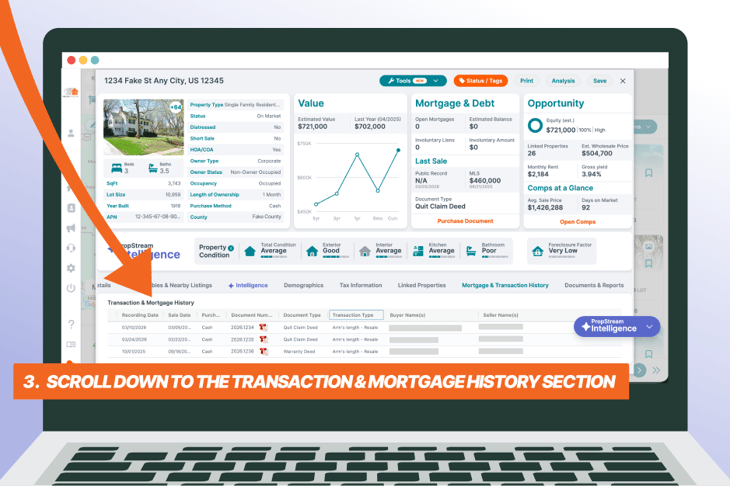
4. Look in the Transaction Type column
.png?width=730&height=487&name=propstream-blog-inline-image-WhatIsAnArmLengthTransaction-SCREENHOT-4-1252x834%20(1).png)
You can also use these steps to identify whether a property has had an arms length or non arm’s length transaction.
- Look for traditional listing exposure: The property was listed on the multiple listing service (MLS) or other online marketplaces prior to sale.
- Confirm the relationship between parties: The buyer and seller have no relationship beyond the real estate transaction.
- Ensure market-aligned pricing: The sale price aligns with market expectations, given comparable nearby properties that recently sold.
|
Red flags that could indicate a non arm’s length transaction include:
|
Common Misconceptions About Arm’s Length Transactions
That said, it’s important to point out that not all off-market deals are non arm’s length.
For example, an investor might offer to buy a property that wasn’t listed for sale for its fair market value. This would still be considered arm’s length.
Furthermore, a “good deal” doesn’t automatically mean it’s non arm’s length. Plenty of on-market transactions result in a win-win deal for both parties. Conversely, a pre-existing relationship between buyer and seller doesn’t always mean unfair pricing. Sometimes, the two still settle on the fair market price (though a pre-existing relationship often impacts price).
Why This Concept Matters More in Today’s Market

Understanding the difference between an arm’s length and a non arm’s length transaction is more important than ever. This is because the housing market is increasingly fragmented.
More and more properties are listed privately or taken off-market, which can make it hard to find reliable comps. This only increases the need for accurate and transparent sales data.
How PropStream Helps You Analyze Transactions Accurately
PropStream gives you access to aggregated data on over 160 million properties nationwide, including transaction histories. When viewing individual property listings, you can see when the property was last sold and for how much, as well as pricing trends over time.
With this much information at your fingertips, you can quickly filter out unreliable points to calculate more accurate comps. If your goal is to make better investment decisions based on real market insights, PropStreaming the property is a strong, reliable option.
Ultimately, understanding how transactions work is the key to making smarter real estate decisions. Use PropStream to access reliable aggregated property data, analyze comparable sales, and evaluate deals with confidence.