

08.13.2026 PropStream
Disclaimer: PropStream does not offer financial or legal advice. This article is for informational purposes only. Be sure to obtain the proper licensing and/or consult financial and legal professionals before advising real estate buyers or sellers.
|
Key Takeaways:
|
Over the last few years, many news headlines have suggested a housing crash is imminent, but so far it hasn’t happened. Instead, a more gradual “housing reset” seems to be taking shape.
In this article, we’ll explain what that means and the implications for prospective homebuyers and sellers.
What Is the “Housing Reset”?
A housing reset is a gradual increase in home sales over time as prices and affordability normalize. While that market forecast has yet to be fully realized, the housing market is trending in that direction.
Here’s why:
Rising Inventory and Shorter Days on Market
In May 2026, the number of U.S. homes for sale increased 5.5% year-over-year. This puts downward pressure on home prices, since it gives buyers more homes to choose from.
Citation: Realtor.com, Housing Inventory: Active Listing Count in the United States [ACTLISCOUUS], retrieved from FRED, Federal Reserve Bank of St. Louis; https://fred.stlouisfed.org/series/ACTLISCOUUS, June 22, 2026.
Meanwhile, the median days on market (the number of days a home is listed before selling or being delisted) increased to 52, up slightly from 51 in May of 2025.
Citation: Realtor.com, Housing Inventory: Median Days on Market in the United States [MEDDAYONMARUS], retrieved from FRED, Federal Reserve Bank of St. Louis; https://fred.stlouisfed.org/series/MEDDAYONMARUS, June 22, 2026.
Mortgage Rates Remain Elevated but Stabilizing
The average 30-year fixed mortgage rate has stayed in the 6-7% range since 2022. As of 18 June 2026, it was 6.47%. It’s safe to say that while rates are significantly above their pandemic-era lows, they’ve stabilized around a “new normal.”
In other words, homebuyers have less purchasing power than they did a few years ago, but they seem to have more confidence to buy now that rates have started to move less erratically.
Increased Buyer Negotiation Power
The net result of these market shifts is a gradual increase in buyers’ negotiation power. This is why the median U.S. home sale price has tapered off. In Q1 2026, it was $403,200, down from its all-time peak of $442,600 in Q4 2022.
For many homebuyers, now may be the time to buy the dip before home values start rising again. After all, home prices are locked in when you purchase, but mortgages can be refinanced when (and if) mortgage rates fall.
Pro Tip: Stay up-to-date on what’s happening in the real estate industry by subscribing to PropStream’s free newsletter.
Why Local Market Knowledge Beats National Headlines

That said, home buying and selling decisions should be made based on what’s happening in a client’s local market more than on national trends.
For one, national housing market figures are aggregates that can hide regional differences. For example, some markets may show signs of growing inventory and softening prices, while others still see competitive bidding. So, it’s better to track and share local housing metrics with clients.
Plus, every city experiences unique market forces across job growth, new construction permits, population shifts, etc., which is exactly why your expertise as a local agent can be so valuable.
How to Educate Anxious Buyers and Sellers
If you’re working with a buyer or seller client who’s anxious about the current housing market, here’s a rubric for guiding them toward the right decision in different scenarios:
|
Client Type |
Concern |
How to Address It |
|
Buyers |
They want to wait for the market bottom before buying. |
Explain that timing the market perfectly is nearly impossible. Mortgage rates can be refinanced later, but the purchase price can’t be changed after the fact. |
|
Buyers |
They’re confused over housing market data. |
Translate metrics like median days on market and inventory levels into what it actually means for their negotiating leverage right now. |
|
Buyers |
They’re hesitant to buy because they’re worried prices might drop. |
Address the fear directly using local market trend data, rather than dismissing the concern. Respect the buyer’s decision. |
|
Sellers |
They don’t know what pricing strategy to follow. |
Explain the two basic strategies: price low to attract interest and potentially incite a bidding war, or price high to allow the price to be negotiated down to a target price. Suggest one based on the market and your experience. |
|
Sellers |
They fear that their home won’t sell at all. |
Help sellers understand that days on market today versus a year ago reflect shifted buyer expectations and market movement, regardless of house prices and interest rates. |
|
Sellers |
They insist on anchoring the home’s value to past comps. |
Address the psychological gap between what their neighbor's house sold for a few years ago and today’s market reality. |
Sample Scripts for Talking to Clients
Here are some example scripts of how to approach an anxious buyer and seller:
Buyer Client Script
“I know the headlines can make this feel scary, but let’s look at what’s actually happening in our area. Inventory here is up, which means you have more options and more room to negotiate than buyers had a couple of years ago. Prices have leveled off, too.
But here’s the thing: Nobody can predict exactly when rates or prices will hit bottom. But if you find a home you love and can comfortably afford, buying now means you lock in today’s price. If rates drop later, you can always refinance. But you can’t go back and change the original price you paid.
So instead of trying to time the market perfectly, let’s focus on what matters most: Does this home fit your life, budget, and goals right now?”
Seller Client Script
“I know it’s tempting to compare this to what your neighbor’s house sold for in 2022, but that was a different market. Today, buyers have more homes to choose from and a little more time to decide, which means pricing strategy matters more than it used to.
Here’s the good news: Homes are still selling. Buyers have come to expect a more competitive, realistic price from the start. If we price it right based on what’s actually happening in our market right now, we can avoid having it sit on the market too long or chasing the price down later. My goal is to get you the best outcome in today’s conditions.”
The Opportunities Hidden Within a Slower, More Balanced Market
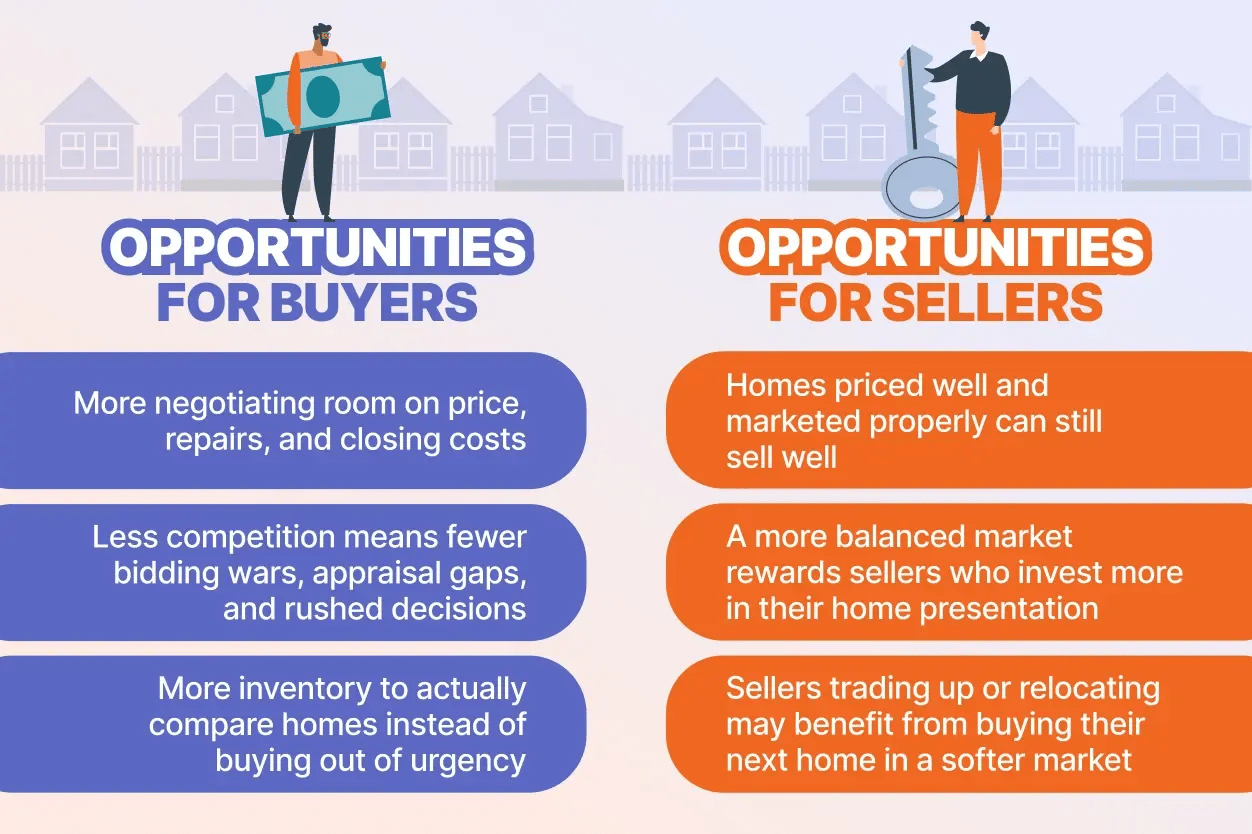
A slower, more balanced housing market isn’t necessarily bad news. It can actually allow for more due diligence and smart decision-making on both sides of the transaction:
| Opportunities for buyers |
Opportunities for sellers |
| More negotiating room on price, repairs, and closing costs |
Homes priced well and marketed properly can still sell well |
| Less competition means fewer bidding wars, appraisal gaps, and rushed decisions |
A more balanced market rewards sellers who invest more in their home presentation |
| More inventory to actually compare homes instead of buying out of urgency |
Sellers trading up or relocating may benefit from buying their next home in a softer market |
Identify New Clients and Market Trends With PropStream
No matter what the current market conditions are, one tool that can always help you improve as an agent is PropStream.
PropStream can help you find listing opportunities, identify cash buyers, run comps, build lead lists, skip trace contact info, and launch outbound marketing campaigns—all from one platform.
*PropStream engages an independent third-party to perform skip tracing.
Notes on sources:
- All U.S. housing market data taken from Redfin (unless otherwise cited).